
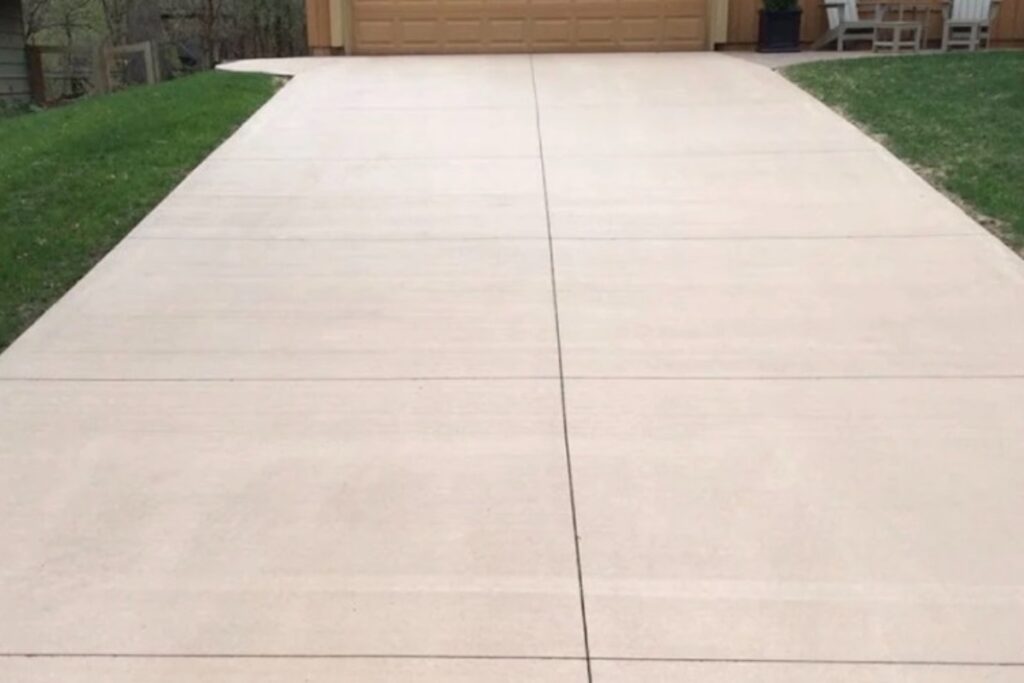
The driveway resurfacing vs replacement decision gets made on the wrong evidence more often than any other call in this trade. Homeowners look at the surface, decide it looks terrible, and conclude the driveway is finished. Contractors quote whichever job they prefer to sell.
The honest version is simpler than either. The surface tells you almost nothing. The slab tells you everything.
Driveway resurfacing vs replacement, decided on the slab
Resurfacing bonds new material to the top of the existing concrete. It renews the wearing surface, corrects minor level problems and gives you a new finish, and it relies completely on the slab underneath being sound and staying still.
Replacement breaks out the old concrete, hauls it away, reworks the base and pours a new slab. It fixes everything, including problems in the ground, and it costs a great deal more work than resurfacing because it is a great deal more work.
So the question is never “how bad does it look”. It is “is the concrete under my feet still doing its job”. Most of that answer is in the cracking, which is why it pays to read what the cracks are telling you before deciding anything.
The conditions that mean resurfacing
Surface wear and scaling on a flat slab. The top has gone sandy, aggregate is showing, the finish has worn off, but the slab is continuous and level. This is the ideal resurfacing candidate and it is extremely common on driveways of a certain age.
Hairline and map cracking without displacement. Fine cracks that have not moved, with no height difference across them and no pieces rocking underfoot. They get treated and covered.
Stains and discolouration. Oil, rust, tyre marks and general weathering. Purely a surface issue.
An outdated or unwanted finish. Plain grey concrete that the owner wants to look like something else. Nothing wrong with the slab at all.
Minor low spots that hold water. Correctable in the build up coats, within limits. A wide, shallow ponding area is fixable. A settled section is not.
If that describes your driveway, the job is driveway resurfacing, and the same work usually extends to the walkway and front porch beside it under resurfacing. Ask each bidder which overlay system they propose and what service life it carries in this climate, because that answer varies more than the price does.
The five conditions that mean replacement
Sections at different heights. If you can put a straight edge across a joint or a crack and see daylight under one side, the ground has moved. An overlay follows whatever shape it is laid on, and it will crack along that line again because the movement has not stopped.
Slabs that rock. Drive onto it and watch. If a piece of concrete visibly moves under a wheel, there is a void under it. The base has washed out or compacted away, and nothing bonded to the top of that piece will survive.
The slab has broken into pieces. Not cracked: broken, into fragments that behave independently. At that point the concrete is no longer a slab, it is a collection of pieces sitting on dirt.
Tree roots underneath. A root running under a driveway lifts it in an arc and keeps lifting it. Resurfacing over that is pouring money into a problem that is still growing. The root has to be dealt with, and once it has been the slab above it is usually beyond saving anyway.
The base has gone. Water finding its way under a slab through open joints and cracks carries fine material out with it over the seasons. What is left is a slab bridging a void, and it will keep cracking until it is supported again. In this part of Georgia, where clay subgrade swells and shrinks through the wet and dry cycle, this is the most common structural cause of a driveway ending its life.
Some of these are borderline. A single settled section on an otherwise sound drive can sometimes be replaced on its own and the rest resurfaced, and a small number of working cracks can be treated as joints rather than defects, which falls under concrete crack repair. Edge and apron damage is the most common reason a driveway looks structurally finished when it is not, and it is covered separately in edges and the apron.
How to run the decision yourself
| What you can see | What it usually means |
|---|---|
| Worn, sandy or scaled surface, slab flat | Resurface |
| Hairline cracks, no height difference | Resurface |
| Stains, tyre marks, dated finish | Resurface |
| Shallow ponding over a wide area | Resurface, with level correction |
| Step across a crack or joint | Investigate the ground first |
| A section that rocks under a wheel | Replace that section at minimum |
| Slab broken into independent pieces | Replace |
| Lifting in an arc near a tree | Replace, after dealing with the root |
Do the straight edge test yourself before anyone quotes. A two metre length of timber laid across every crack and joint on the drive takes ten minutes and tells you more than a photograph ever will. Then, if resurfacing is the answer, read what happens during the work.
The mistake that costs the most
Resurfacing a driveway that needed replacing is the expensive outcome, because you pay for the overlay, watch it fail along the same lines as the original, and then pay for the replacement including the removal of the overlay you just bought.
Any contractor who quotes resurfacing without walking the drive, without laying a straight edge across the cracks and without asking where the water goes has not established which job you need. That is the question to put to every bidder before you compare a single number.
What a proper assessment looks like
The estimator should walk the whole drive rather than the first few metres of it, lay a straight edge across every significant crack and joint, and note which way the drive falls and where the water leaves it. They should look at the apron where the drive meets the street, because that section carries the heaviest load and shows structural trouble first. They should ask when the driveway was poured, whether anything has been repaired before, and whether anything heavy has been parked or delivered on it.
Then they should tell you which job you need, including when the answer is the one they were not hoping to sell. A contractor who resurfaces everything, or one who replaces everything, is not assessing anything. For a driveway that is genuinely borderline, the right answer is often to fix the drainage and reseal the joints, live with it for a season, and find out whether the movement has stopped before committing to either job.
Frequently asked questions
Can any concrete driveway be resurfaced?
No. Resurfacing renews the top of a slab and relies on the slab underneath being sound and stable. If the concrete has broken into sections that move independently, if parts of it have settled, or if the base beneath it has washed out, an overlay will fail in the same places the original did and usually faster.
How do I know if my driveway needs replacing rather than resurfacing?
Look for movement rather than wear. Sections at different heights, cracks with a step across them, pieces that rock under a car wheel, and cracks that reopen after being repaired all point at the slab or the ground beneath it. Surface wear, scaling, discolouration and hairline cracking on a flat, stable slab all point at resurfacing.
Will cracks come back through a resurfaced driveway?
Working cracks will, unless they are treated as joints and carried through the new surface rather than filled and covered. That is the difference between a resurfacing that lasts and one that shows the old crack pattern within a year. Ask specifically how existing cracks and joints are handled before you accept a quote.
Is resurfacing a driveway cheaper than replacing it?
Resurfacing involves far less work: no demolition, no disposal of the old slab, no new base preparation and no new pour. That makes it the less expensive option in almost every case where it is technically appropriate. It stops being the cheaper option when it is the wrong job, because a failed overlay has to be removed before the replacement that was needed all along.
How long does a driveway need to be off limits after resurfacing?
Foot traffic returns before vehicle traffic, and vehicle traffic returns before you should be turning wheels on the spot or parking anything heavy. Ask for both times in writing. Point loads from a jack, a trailer tongue or a dumpster are what damage a curing surface, more than driving on it.