
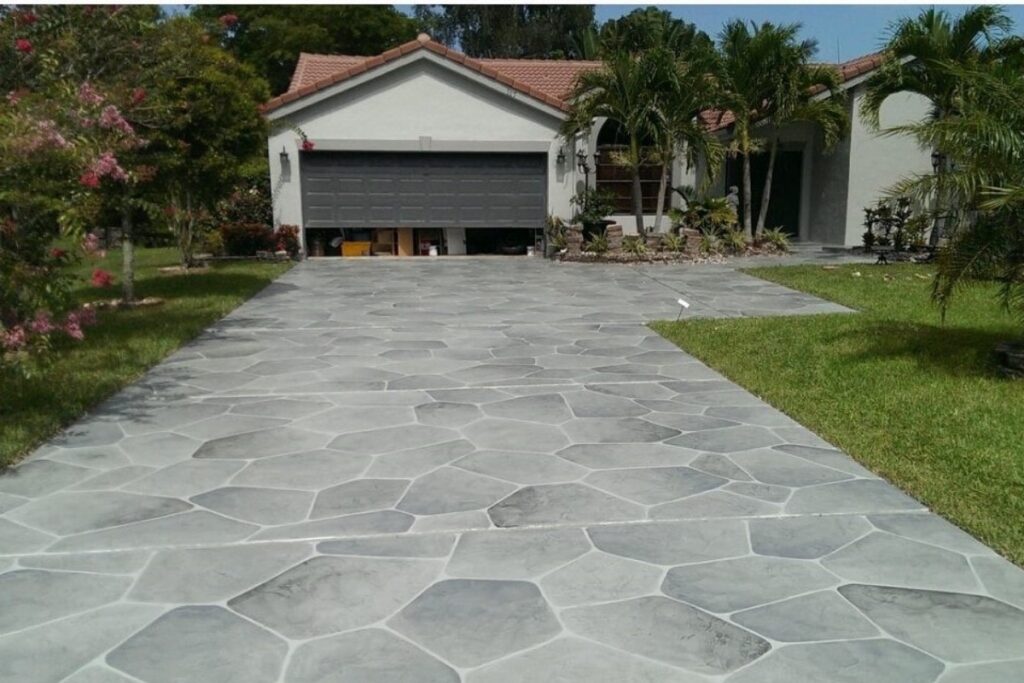
A driveway that is breaking up along both sides looks like a driveway that is finished. It usually is not. Driveway edge repair is a much smaller job than most homeowners assume, and edge damage is the single most common reason a perfectly sound slab gets torn out and replaced.
The reason edges fail first is structural, and once you understand it the repair sequence becomes obvious, including the part that almost every quick fix leaves out.
Why edges fail when the middle is fine
Concrete is strong in compression and weak in tension. A slab supported evenly underneath is mostly in compression and it does very well. An edge is a different situation entirely.
There is nothing beside it. The middle of a slab is confined by concrete on all sides. The edge is confined on one side only. Load applied near an edge tries to bend it, and bending puts the concrete in tension, which is the condition it handles worst.
It is often thinner. Good practice thickens the edge of a slab for exactly this reason. Plenty of residential driveways were poured without a thickened edge, and the outer strip is the same depth as the middle or less.
The ground beside it disappears. This is the mechanism that does most of the damage. Water running off the drive, out of a downspout, or down a slope above it concentrates along the edge and erodes the soil there. The strip beside the drive drops lower than the concrete. Now the edge has no lateral support and nothing to spread load into, and every wheel that runs slightly wide is bending an unsupported cantilever.
Wheels run off it. Reversing out, pulling in past a parked car, a delivery van misjudging the width. Look for a rut in the ground running parallel to the edge. Where that rut exists, the edge above it is being loaded in the worst possible way and it will break up along that length.
The apron is a different problem again
The apron, the section where the drive meets the street, takes more punishment than any other part of the driveway. Every vehicle crosses it, including the heavy ones that never come further up: delivery trucks, refuse trucks, the occasional utility vehicle. It usually sits at a transition in level and grade. And it is often the oldest concrete on the property, or the newest, if a utility cut was made through it at some point and patched back.
There is one thing to check before commissioning any work there. The apron frequently sits partly within a public right of way, and the boundary between your property and the road allowance is not always where the concrete changes. Some jurisdictions require notification or a permit for work in that strip. Check with your county or city first, and be wary of any contractor who does not raise it.
Does a broken edge mean the driveway is finished
Almost never on its own. Go and look at the middle of the drive, and ask three questions.
Is the body of the slab level, with no steps across cracks or joints? Does anything rock when a wheel goes over it? Are there cracks with a height difference across them, away from the edges?
If the answers are yes, no and no, the slab is doing its job and the failure is confined to the unsupported perimeter. That is a repair. The straight edge test that answers those questions is in what the cracks mean, and the full decision framework is in resurface or replace. Once the edges are sound, renewing the whole surface is driveway resurfacing.
What edge damage is not
Surface loss along the edge, where the concrete has gone sandy and aggregate is showing but the edge itself is intact and full depth, is a surface problem rather than a structural one. It has different causes and a different repair. The distinction matters: one is fixed by resurfacing, the other is not.
Driveway edge repair, and what has to happen first
The order is not negotiable, and the first step is the one that gets skipped.
One: restore the ground. The soil beside and under the edge gets rebuilt and compacted back up to the level of the concrete. Without this, anything built on top is a new edge sitting over the same void, and it fails the same way.
Two: stop the water that caused it. If a downspout is discharging along the edge, extend it. If run off from the drive itself is concentrating at one point, that has to be dealt with, or the ground you just rebuilt washes out again.
Three: cut back to sound concrete. Broken edge material gets removed back to a clean line in concrete that is still solid, not feathered onto the crumbling remains of the old edge.
Four: rebuild the edge. The new edge is formed, placed and bonded to the sound concrete, full depth rather than as a facing. A repair that is only a facing will detach at the first wheel load.
Five: resurface across the whole drive. Otherwise the repair is the most visible thing on the driveway, because new concrete never matches old. How edges sit within the full scope is set out in how edges are handled during resurfacing. The repair itself falls under concrete crack repair.
Keeping a repaired edge repaired
Bring the ground beside the drive up level with the concrete and keep it there, grassed or gravelled rather than bare. Bare soil beside a driveway erodes, and the moment it drops below the concrete the cycle restarts.
Keep water moving away from the edge rather than along it. Watch where wheels actually run and, if there is a habitual line that clips the edge, widen the drive, add a gravel shoulder or add something visible to steer around. And treat a newly repaired edge gently for the first month, because edges reach full strength later than the middle of a slab, which is covered in the first thirty days.
The short answers to the most common versions of this question are in answers to the questions we get most.
Frequently asked questions
Why do driveway edges crumble but the middle stays fine?
Because the middle of a slab is supported on all sides and the edge is not. Concrete at an edge is usually thinner, it has no lateral support, and it carries the same wheel loads as the middle. Add soil eroding away beside it and you have an unsupported cantilever taking a car wheel, which is exactly the condition concrete is worst at.
Can a broken driveway edge be repaired, or does the whole drive need replacing?
In most cases it is repairable, and edge damage is the single most common reason a perfectly sound driveway gets written off. The test is what the body of the slab is doing. If the middle is level, stable and free of settlement cracks, the drive is not finished and rebuilding the edges is a far smaller job than replacement.
What causes the soil beside a driveway to wash away?
Water with nowhere else to go. Run off from the drive itself, from a downspout, or from a slope above it, concentrated along the edge where there is nothing to slow it down. Bare soil erodes fastest, which is why a grassed or gravelled shoulder that is level with the concrete lasts far better than a bare strip that sits lower than the drive.
Is the driveway apron my responsibility or the city’s?
It depends on where you live and where the property boundary sits, and the apron often falls partly within a public right of way. Check with your county or city before commissioning work on it, because some jurisdictions require notification or a permit for work in that strip and some take responsibility for part of it. Any contractor working there should be asking the same question.
Will resurfacing fix crumbling driveway edges?
Not on its own. An overlay is bonded to the top of the concrete and it cannot create support that is not there underneath. The sequence is to restore the ground beside and under the edge, rebuild the concrete edge itself, and then resurface across the whole drive so the repair is not the most visible thing on it.