
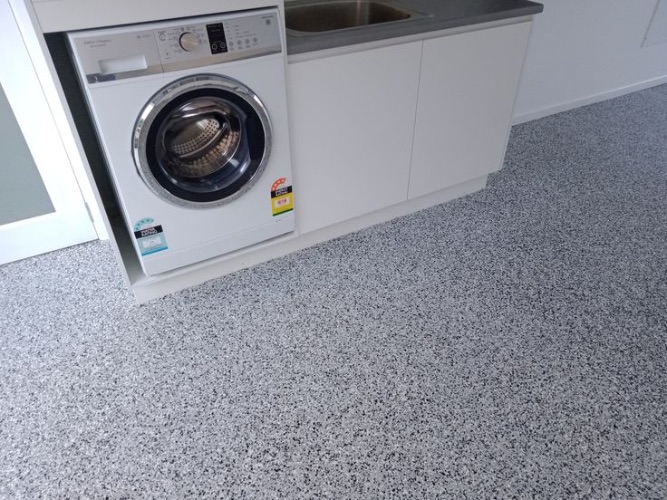
A non-slip pool deck has to do three things that pull against each other. It has to grip a wet bare foot. It has to be comfortable to stand on for an hour in August. And it has to come clean without a pressure washer every fortnight. Push any one of those to the limit and you lose one of the others.
Most people choose a finish from a colour board. The colour is the least consequential part of the decision.
How a non-slip pool deck surface actually works
Grip on a wet surface comes from two things: the microscopic roughness of the material, and the space for water to go. A smooth surface with water on it lets a foot ride on a thin film. A textured surface breaks that film, because the high points carry the load and the low points give the water somewhere to sit.
That is why texture depth matters more than the material. It is also why a texture can be ruined after the fact. Fill the low points with a heavy film forming sealer and the water has nowhere to go again, and a deck that gripped when it was new becomes slippery without changing colour at all.
The industry measures this as a coefficient of friction, and there are published test methods for wet surfaces from bodies including ANSI and ASTM. Numbers from a laboratory panel do not transfer cleanly to a five year old deck with sunscreen on it, so treat them as a comparison between products rather than a promise about your deck.
The four textures you will actually be offered
Knockdown. Material is sprayed or splattered onto the surface to create peaks, then a trowel is passed over lightly to flatten the tops. You end up with flat bearing surfaces for a foot and open channels between them for water. It is the default for a reason: good wet grip, comfortable barefoot, and it hides minor imperfections in the slab below.
Splatter or lace. The same spray without the knockdown pass, leaving the peaks sharp. Grip is excellent. It is noticeably harsher underfoot and it holds more dirt in the valleys, so it suits pool surrounds where people mostly walk rather than lie down.
Broom finish. The texture on most plain concrete. Straight parallel grooves that grip well in the direction across the grooves and less well along them. Cheap, honest and unforgiving on bare feet, and it collects grit in the lines.
Sprayed cool deck textures. A cementitious sprayed finish with a fine, open profile, common on older decks throughout the south. It runs cooler than most alternatives and grips well, and it is more vulnerable to delamination at the edges as it ages. What can be saved on a failing one depends on how much of it still rings solid when you tap it, not on how bad the surface looks.
Smooth and polished finishes belong indoors. Inside the splash zone they are a liability, and no sealer additive turns one into a safe deck.
Texture is a finishing decision, not a product decision
The same overlay can be finished any of those ways, which surprises people who assumed texture came with the product. Product family determines thickness, durability, colour options and how the material behaves during application. Texture is what the crew does with a trowel in the last hour. Both decisions get made and they get made separately, so ask for the product family and the texture by name rather than accepting one answer for both. The sequence they sit inside is in how the deck gets built up.
Heat is the trade-off nobody mentions until August
Surface temperature in full Georgia sun is driven by colour first and texture second. Darker pigments absorb more solar energy and hold it. A pale deck in the same sun is meaningfully more usable barefoot at four in the afternoon.
Texture helps too, and for a reason people do not expect. A textured surface puts less of itself in contact with a foot at any moment, and it sheds heat faster once it is shaded or wetted. A dark smooth deck is the worst of both. A pale textured deck is the best of both, and it is the reason so many southern pool decks are finished in off whites, sands and light greys rather than the darker tones people pick on a screen in February.
Shade changes the arithmetic. A deck under mature trees can carry a darker colour comfortably, and it brings a different problem instead.
The most slippery pool deck is a clean one that stopped being cleaned
In this climate, the majority of slip complaints on decks that were fine when new come down to a biological film. Warm, humid, shaded and regularly wet is the ideal condition for algae and mildew, and the film they leave is slick, thin and almost invisible on a light coloured surface. It is worst on the north side of the house, under overhangs and anywhere a downspout discharges.
The clue is that the deck is slippery in some places and not others, and that the slippery places are the shaded ones. That is not a texture problem and resurfacing will not fix it. It needs cleaning on a schedule, and it needs the shade and damp conditions addressed where they can be.
Sealer choice can undo the texture
Sealers do useful work. They protect pigment from ultraviolet light, they resist pool chemicals and they make the surface cleanable. They also sit on top of the profile you paid for.
A heavy film forming sealer applied generously will level out a fine texture. A penetrating sealer soaks in and changes the profile far less. A third option is a slip resistant aggregate broadcast into or mixed through the final sealer coat, which restores grip on a surface that has been over sealed. Ask which approach is being used and how often the sealer needs renewing, because renewal is the recurring maintenance item on any coated deck and it drives how long the finish lasts.
Getting the specification right
Ask for the texture by name rather than by picture. Ask to see or stand on a finished sample of that exact texture in that exact colour, outdoors, ideally wet. Ask what sealer goes over it and whether it films. And ask whether the same texture will be carried onto the adjoining patio or steps, because a change of grip at a step edge is where people fall.
Steps and coping have their own rules, and they are not always inside the scope of a deck job. That boundary is set out in what resurfacing does not cover. For the installed service see pool deck resurfacing, for the surrounding hard surfaces see resurfacing, and for finish ideas that carry across the whole back of the house there is patio resurfacing ideas around Atlanta.
Frequently asked questions
What is the least slippery pool deck surface?
A textured overlay finish, knockdown or splatter, gives the best combination of wet grip and barefoot comfort for a residential deck. Broom finished concrete grips well but is harsh on bare feet and holds dirt. Smooth finishes and polished surfaces have no place inside the splash zone regardless of what sealer is used on them.
Does sealer make a pool deck slippery?
It can. A film forming sealer applied heavily will bridge across a texture and fill in the low points, which flattens the profile that was providing the grip. The fix is either a penetrating sealer that does not build a film, or a slip resistant aggregate mixed into the final sealer coat. Ask which one is being used before it goes down.
How do I stop my pool deck being slippery when wet?
Work out whether the problem is the texture or the film on top of it. If the deck was never slippery and now is, it is almost certainly a biological film from shade and damp, and it cleans off. If it has been slippery since it was built, the surface profile is wrong and only resurfacing with a proper texture fixes it.
Do darker pool deck colours get hotter?
Yes. A darker surface absorbs more solar energy and runs hotter underfoot in full sun, which matters in a Georgia July. Texture helps as well as colour, because a textured surface puts less material in contact with a bare foot at any one moment and sheds heat faster once shaded or wetted.
Can you add grip to an existing pool deck without resurfacing it?
Sometimes. If the deck is structurally sound and the only problem is a smooth or over sealed surface, a slip resistant additive in a fresh sealer coat can improve it noticeably. That is a surface treatment with a shorter life than resurfacing, and it will not rescue a deck that is spalling, hollow or holding water.