
Almost every unhappy pool deck job we hear about was a scope misunderstanding rather than a workmanship failure. The surface was fine. The owner expected the coping, or the tile, or the furniture, or the planting to be part of it, and it was not.
Pool deck resurfacing scope is narrower than most people assume, and the boundary sits in an awkward place, because the things immediately either side of a deck belong to different trades. Here is the line, drawn properly.
Pool deck resurfacing scope, item by item
| Element | Normally in scope | Whose work it is if not |
|---|---|---|
| Deck surface | Yes | |
| Preparation and cleaning of the deck | Yes | |
| Repairs to the deck slab | Yes | |
| Joints in the deck, including at the coping | Yes | |
| Sealer over the new surface | Yes | |
| Coping stones | Usually not | Mason or pool builder |
| Waterline tile | No | Pool builder or tiler |
| Pool interior finish | No | Pool builder |
| Skimmer, returns, plumbing | No | Pool service |
| Electrical bonding, lighting, rails wiring | No | Licensed electrician |
| Screen enclosure and its footings | No | Enclosure company |
| Fence, gate and latches | No | Fencing contractor |
| Planting and beds | Protection yes, restoration no | Owner or gardener |
| Moving and replacing furniture | Usually not | Owner |
| Refilling and balancing the pool | No | Pool service |
What is being bought is on the pool deck resurfacing page, and the sequence the work follows is in what happens on site.
What is inside the scope
The deck itself, all of it: preparation, removal of delaminated material, repair of spalls and unsound areas, treatment of cracks, treatment of joints including the expansion joint at the coping, the overlay and the sealer. Deck repairs sit under concrete crack repair when they are being done on their own.
Protection is in scope too, and it should be stated: the pool covered or the level dropped, the tile line masked, the equipment pad sheeted, the coping protected, planting beds covered, house walls masked. If a proposal is silent on protection, ask, because a crew that has not priced protection has not planned it.
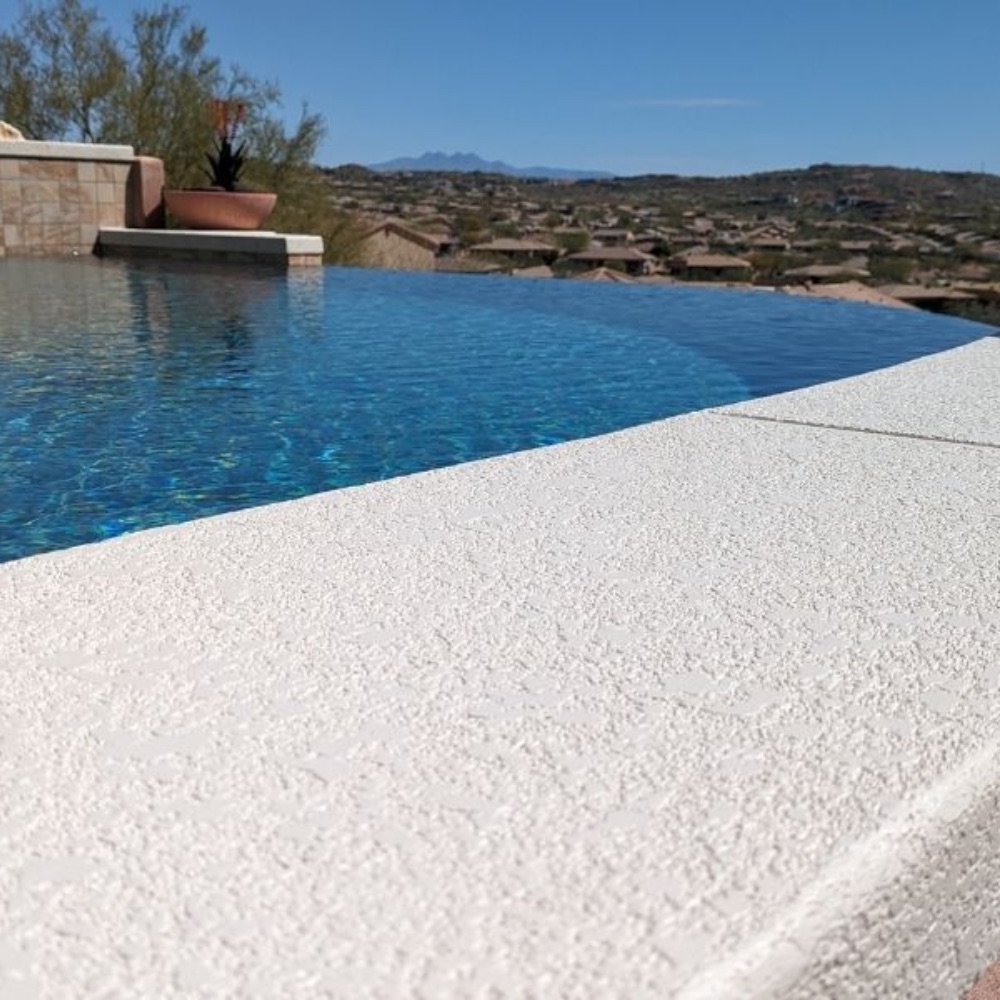
Sprayed deck finishes follow exactly the same boundary. The sprayed texture is deck surface and it stops at the coping, like everything else on this list.
Coping, and why it is a separate decision
Coping is the band of material capping the pool edge, and it does a structural job as well as a visual one. It is masonry, not deck surface, and replacing or resetting it is a different trade with different materials.
There is one nuance worth knowing. Cantilevered concrete coping, where the deck concrete itself was formed over the pool edge, is sometimes continuous enough with the deck that an overlay can be carried across it. Stone, brick and precast coping cannot be, and should not be. If your coping is loose, cracked or has stones that rock, that is work to sequence before the deck rather than after, because it disturbs the deck edge.
Whatever happens to the coping, the joint between it and the deck is in scope. That joint is the entry route for water going under the slab, and cleaning it out and resealing it is part of the deck work.
Anchors, rails and the electrical question
Handrail and ladder anchors sit in the deck and the rails usually have to come out for the work. Who removes them, who stores them and who reinstalls them needs settling in advance, and reinstallation is not always as simple as it looks if the anchor is corroded.
Then there is bonding. Pool decks have electrical bonding requirements under the National Electrical Code, and equipotential bonding around the pool perimeter is a safety system rather than a finish. A resurfacing overlay generally sits on top of the existing concrete and does not disturb it. But if unsound concrete is being cut out, or anchors are being removed and reset, that is a question for a licensed electrician, and it is a question to ask before the work rather than after it. No deck contractor should be making that call.
The screen enclosure, the fence and the gate
Screen enclosures sit on footings in or beside the deck. The enclosure is not deck work, the footings are not deck work, and modifying either is somebody else’s job. What is deck work is working around them, masking the frame, and detailing the new surface neatly where it meets each upright. That takes time and it belongs in the quote, which is why the enclosure should be mentioned before the estimator visits rather than discovered by them.
Fences, gates and latches are the same. A gate that swung clear over the old surface may not clear a new one if the build up has changed the level at the swing. Raise it early.
Steps, and where the texture stops
Deck steps up to the house or down to the yard are usually inside the scope if they are part of the deck. Steps into the water are not: those are part of the pool shell.
The thing to settle explicitly is where the new texture stops. A change of grip at a step edge is exactly where people fall, so the texture should run continuously through any change of level that is inside the scope, and any point where the new surface meets an old one should be a deliberate detail rather than an accident. That reasoning is in texture and slip resistance.
The things around the deck
Furniture, planters, umbrella bases and toys are the owner’s to move, before and after. Planting beds against the deck get protected during the work, but restoring anything damaged or overgrown is not deck work. Irrigation heads and low voltage lighting in or beside the deck should be pointed out before sheeting goes down and hides them.
Hidden damage found once work starts
Preparation reveals things a survey cannot. More delamination than expected is normal and is not a sign of a bad contractor. What matters is that the proposal already says what happens: an allowance, a stated rate for additional area, and written approval before extra work goes ahead. The categories of damage that turn up are set out in reading the damage.
Settle it in the proposal, not on the day
Every line in the table above is worth a sentence in the scope, particularly the exclusions. A proposal that lists what is not included is not being defensive, it is being clear, and it is the single best predictor of a job that ends without an argument.
The wider set of questions to put to a bidder is in choosing a contractor, and the short answers to the most common scope questions are in answers to the questions we get most.
Frequently asked questions
Does pool deck resurfacing include the coping?
Usually not. Coping is a separate element sitting between the deck and the pool, and replacing or resetting it is masonry work rather than resurfacing. Some overlays can be carried over cantilevered concrete coping where it is sound and continuous with the deck, but stone, brick and precast coping is its own scope and its own decision. Ask specifically, because it changes both the price and the finished appearance.
Is the waterline tile part of a deck resurfacing job?
No. Waterline tile is inside the pool, below the coping, and it belongs to a pool builder or tiler rather than a deck contractor. If the tile is failing at the same time as the deck, sequence the tile work first, because it is inside the shell and it is easier to do before a new deck surface is in place than after.
Who is responsible for the electrical bonding around a pool deck?
A licensed electrician. Pool decks have bonding requirements under the National Electrical Code, and equipotential bonding around the pool perimeter is a safety system rather than a finish. A resurfacing overlay generally sits on top of existing concrete and does not disturb it, but if anything is being cut out, or if anchors and rails are being removed and reset, raise it with an electrician before the work rather than after.
Will the contractor put my furniture and planters back?
Assume not unless the proposal says so. Moving items off before the job and back afterwards is usually the owner’s responsibility, and anything heavy or fragile should be dealt with before the crew arrives. Where beds and planting run against the deck edge, protection during the work should be in the scope even when restoration is not.
What happens if more damage is found once work starts?
It should already be answered in the proposal, with an allowance for repair, a stated rate for anything beyond it, and a requirement that you approve additional work in writing before it goes ahead. Without that clause, the conversation happens with a half prepared deck, no leverage and a crew standing still, which is the worst position to negotiate from.