EnviroDek Epoxy Flooring Contractor in Atlanta, GA

pool-deck-resurfacing

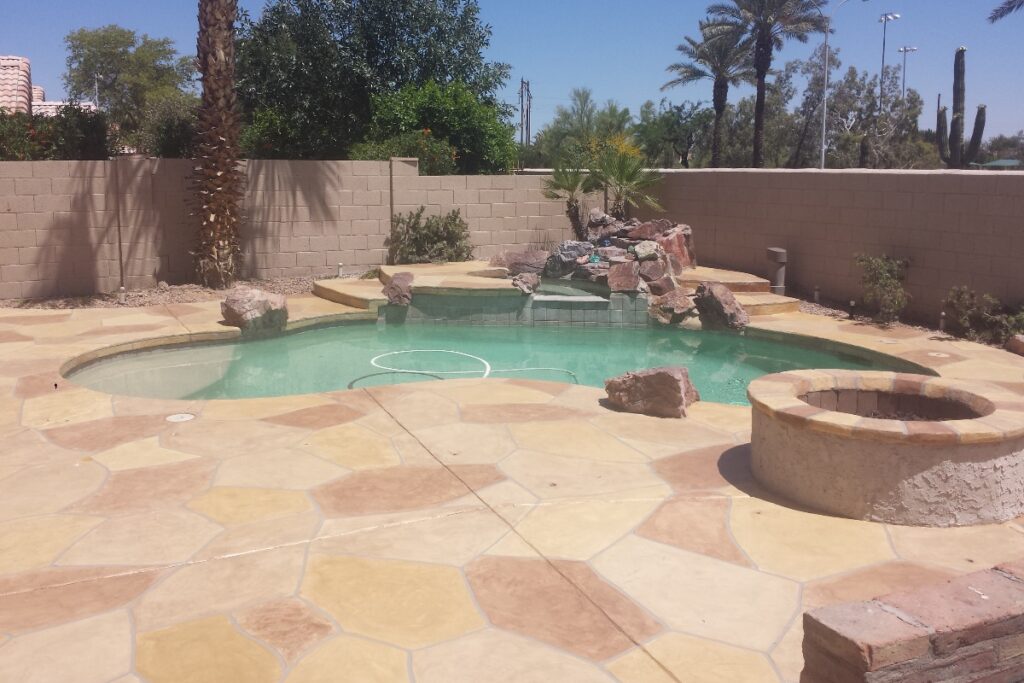
Concrete pool deck resurfacing finished around a residential pool
pool-deck-resurfacing

How Long Does Pool Deck Resurfacing Last in Georgia?

How long does pool deck resurfacing last is the question every homeowner asks second, right after the price. It is also the question that gets the least useful answer, because most of what determines the outcome is decided in the two days before the first coat goes down, and none of it is visible in the finished deck. Here are the five things that set the service life, in the order of how much they matter, and the one you keep control of afterwards. Preparation sets the ceiling and nothing later raises it An overlay is only as good as its bond to the concrete underneath. That bond is created mechanically, by grinding or shot blasting the deck to open the surface and give the new material something to key into. Nothing applied later improves a bad bond. No premium product compensates for it. No amount of maintenance rescues it. The failure is also delayed, which is what makes it so common. A deck coated over a pressure washed surface looks perfect for a season or two, then lifts at the edges, blisters in the sun and comes away in sheets. By then the crew has gone. What proper preparation actually involves, and how you check that it happened, is in how the deck is prepared and built up. If you take one thing from this article: preparation is the single largest determinant of how long the deck lasts, and it is the first thing cut from a cheap bid. What was under it when you started A sound slab and a compromised one give you different ceilings. Delaminated areas that were cut out and rebuilt are fine. Delaminated areas that were coated over are a countdown. Cracks that were treated as joints stay quiet. Cracks that were filled and covered come back through the new surface, usually within the first year of seasonal movement. The other thing that carries over is the original slab quality. A deck poured with a weak, overworked surface layer will keep giving up that layer at the edges of any repair, and a deck poured over a poorly compacted base will keep moving no matter what is bonded to the top of it. Neither is a reason not to resurface, and both are reasons to know before you start rather than after. Movement in the slab itself is the hardest case. If the ground under the deck is moving, because water is washing fines out of the base or because clay soil is swelling and shrinking, the surface on top will keep telegraphing that movement no matter how well it was applied. Water that does not leave is the fastest way to shorten the life Standing water is the most underrated variable on this list. A deck that holds puddles after every storm stays saturated for hours longer than one that drains. Saturated surfaces deteriorate faster, water works into joints and edges, and the shaded damp areas grow the biological film that makes a deck slippery and stains it. The tell is that damage matches the shape of the puddle. If the surface is sound everywhere except inside an outline you recognise from the last rainstorm, drainage is your problem and resurfacing without fixing it just resets the clock on the same failure. That is treated properly in where the water goes. Sun, chemistry and what they actually attack Ultraviolet exposure works on pigment and on the sealer, not on the structure of the overlay. In practice that shows up as colour depth fading on the sun side of the deck while the shaded side stays truer, which is why the shade line is often visible on an older deck. Choosing a system with ultraviolet stable pigment matters more here than in most of the country, because a deck in north Georgia gets a long, intense season of it. Pool chemistry works on the surface. Splash out carries chlorine or salt onto the deck continuously through the summer, spilled chemicals near the equipment pad are more aggressive still, and some cleaning products people use on decks are harsher than the pool water ever is. Salt systems change this picture enough to be worth reading separately: see what salt does to a deck. The sealer is the consumable, not the deck This is the distinction most homeowners have never had explained. The overlay is the deck. The sealer is a wearing layer on top of it that takes the ultraviolet exposure, the chemicals and the foot traffic, and it is designed to be renewed. It wears fastest along the routes people actually walk, which is why a five year old deck often shows a duller band between the back door and the pool steps. Renewing the sealer on schedule is the cheapest thing you can do for the deck, and it protects everything under it. Letting it go until the colour has faded and the surface has started to take on stains means the damage has reached the layer you cannot renew. Sealer type is chosen at specification stage, alongside texture and sealer selection, and the choice affects both grip and renewal frequency. The signs that the clock is running out Colour going flat and chalky across the whole deck rather than in one area. Stains that no longer clean off. Hollow sounding areas appearing where the deck rang solid before. Edges lifting anywhere, particularly at the coping joint and at steps. Texture worn smooth in the traffic lanes so the deck is slippery where it used to grip. Individually, several of those are maintenance. Together they mean the surface is at the end of its life, and the assessment is the same one described in reading the damage. So how long does pool deck resurfacing last, and is it worth it Resurfacing renews the part of a pool deck that wears out while keeping the part that does not. If the slab is sound, that is a good trade, and at the end
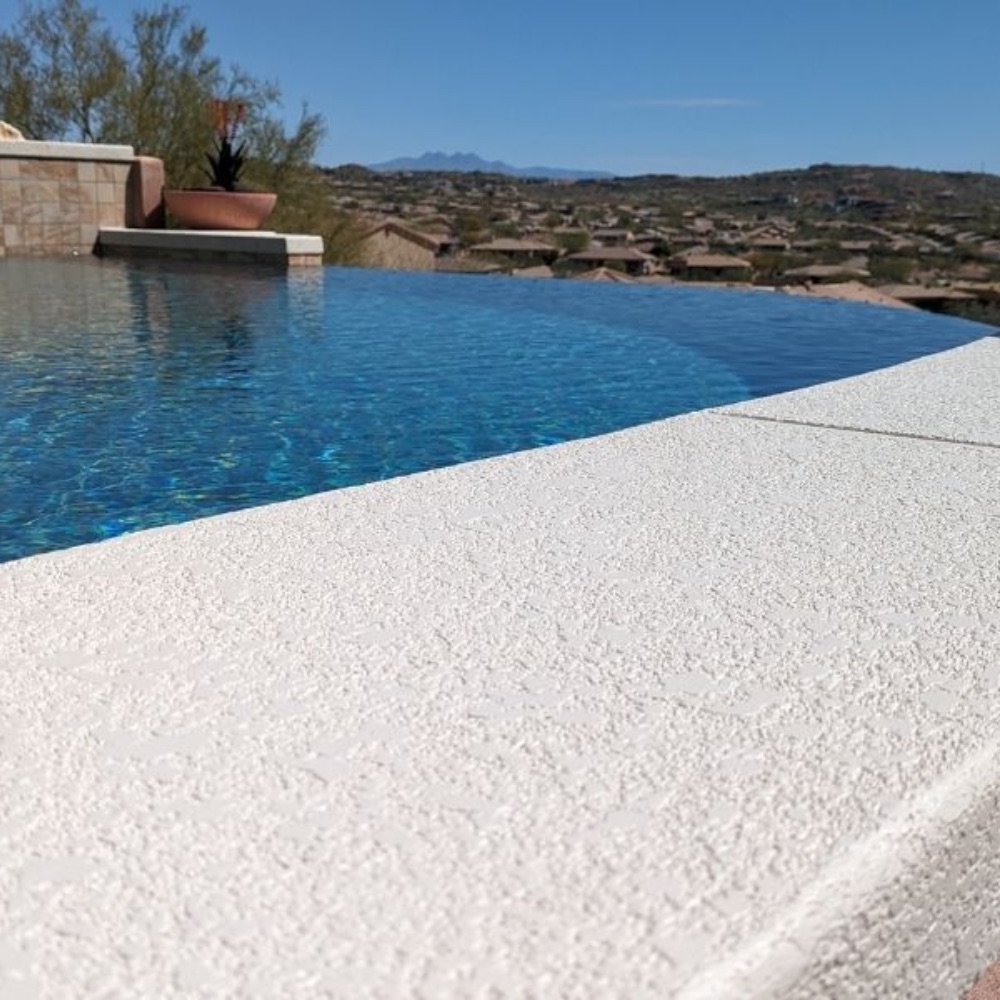
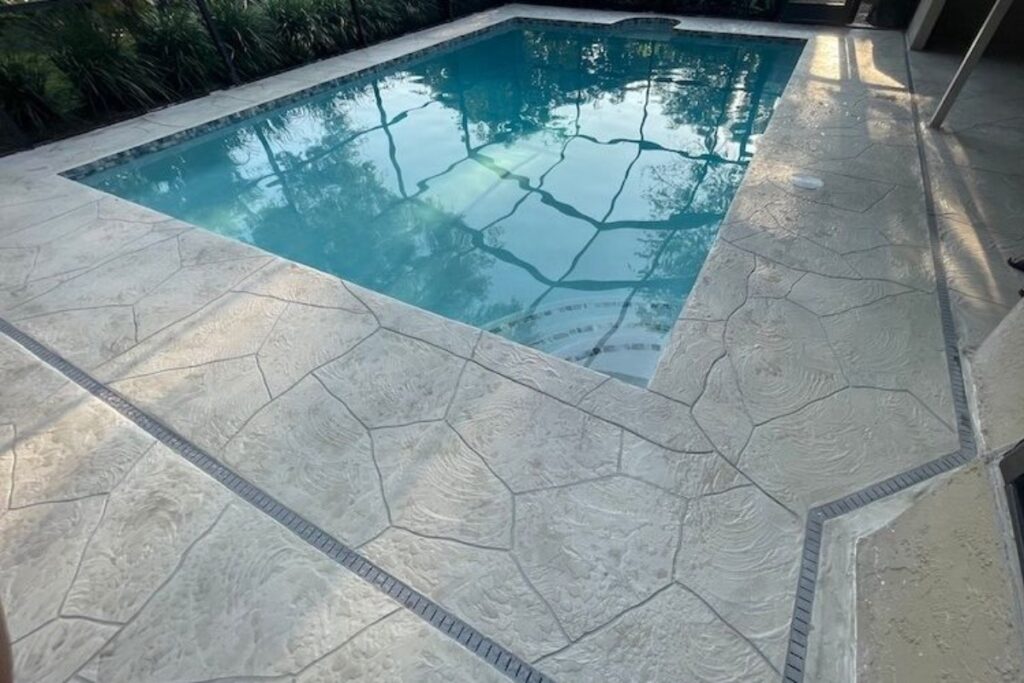
Textured non-slip concrete pool deck surface
pool-deck-resurfacing

Choosing a Non-Slip Pool Deck Finish in Georgia Heat

A non-slip pool deck has to do three things that pull against each other. It has to grip a wet bare foot. It has to be comfortable to stand on for an hour in August. And it has to come clean without a pressure washer every fortnight. Push any one of those to the limit and you lose one of the others. Most people choose a finish from a colour board. The colour is the least consequential part of the decision. How a non-slip pool deck surface actually works Grip on a wet surface comes from two things: the microscopic roughness of the material, and the space for water to go. A smooth surface with water on it lets a foot ride on a thin film. A textured surface breaks that film, because the high points carry the load and the low points give the water somewhere to sit. That is why texture depth matters more than the material. It is also why a texture can be ruined after the fact. Fill the low points with a heavy film forming sealer and the water has nowhere to go again, and a deck that gripped when it was new becomes slippery without changing colour at all. The industry measures this as a coefficient of friction, and there are published test methods for wet surfaces from bodies including ANSI and ASTM. Numbers from a laboratory panel do not transfer cleanly to a five year old deck with sunscreen on it, so treat them as a comparison between products rather than a promise about your deck. The four textures you will actually be offered Knockdown. Material is sprayed or splattered onto the surface to create peaks, then a trowel is passed over lightly to flatten the tops. You end up with flat bearing surfaces for a foot and open channels between them for water. It is the default for a reason: good wet grip, comfortable barefoot, and it hides minor imperfections in the slab below. Splatter or lace. The same spray without the knockdown pass, leaving the peaks sharp. Grip is excellent. It is noticeably harsher underfoot and it holds more dirt in the valleys, so it suits pool surrounds where people mostly walk rather than lie down. Broom finish. The texture on most plain concrete. Straight parallel grooves that grip well in the direction across the grooves and less well along them. Cheap, honest and unforgiving on bare feet, and it collects grit in the lines. Sprayed cool deck textures. A cementitious sprayed finish with a fine, open profile, common on older decks throughout the south. It runs cooler than most alternatives and grips well, and it is more vulnerable to delamination at the edges as it ages. What can be saved on a failing one depends on how much of it still rings solid when you tap it, not on how bad the surface looks. Smooth and polished finishes belong indoors. Inside the splash zone they are a liability, and no sealer additive turns one into a safe deck. Texture is a finishing decision, not a product decision The same overlay can be finished any of those ways, which surprises people who assumed texture came with the product. Product family determines thickness, durability, colour options and how the material behaves during application. Texture is what the crew does with a trowel in the last hour. Both decisions get made and they get made separately, so ask for the product family and the texture by name rather than accepting one answer for both. The sequence they sit inside is in how the deck gets built up. Heat is the trade-off nobody mentions until August Surface temperature in full Georgia sun is driven by colour first and texture second. Darker pigments absorb more solar energy and hold it. A pale deck in the same sun is meaningfully more usable barefoot at four in the afternoon. Texture helps too, and for a reason people do not expect. A textured surface puts less of itself in contact with a foot at any moment, and it sheds heat faster once it is shaded or wetted. A dark smooth deck is the worst of both. A pale textured deck is the best of both, and it is the reason so many southern pool decks are finished in off whites, sands and light greys rather than the darker tones people pick on a screen in February. Shade changes the arithmetic. A deck under mature trees can carry a darker colour comfortably, and it brings a different problem instead. The most slippery pool deck is a clean one that stopped being cleaned In this climate, the majority of slip complaints on decks that were fine when new come down to a biological film. Warm, humid, shaded and regularly wet is the ideal condition for algae and mildew, and the film they leave is slick, thin and almost invisible on a light coloured surface. It is worst on the north side of the house, under overhangs and anywhere a downspout discharges. The clue is that the deck is slippery in some places and not others, and that the slippery places are the shaded ones. That is not a texture problem and resurfacing will not fix it. It needs cleaning on a schedule, and it needs the shade and damp conditions addressed where they can be. Sealer choice can undo the texture Sealers do useful work. They protect pigment from ultraviolet light, they resist pool chemicals and they make the surface cleanable. They also sit on top of the profile you paid for. A heavy film forming sealer applied generously will level out a fine texture. A penetrating sealer soaks in and changes the profile far less. A third option is a slip resistant aggregate broadcast into or mixed through the final sealer coat, which restores grip on a surface that has been over sealed. Ask which approach is being used and how often the sealer needs renewing, because renewal

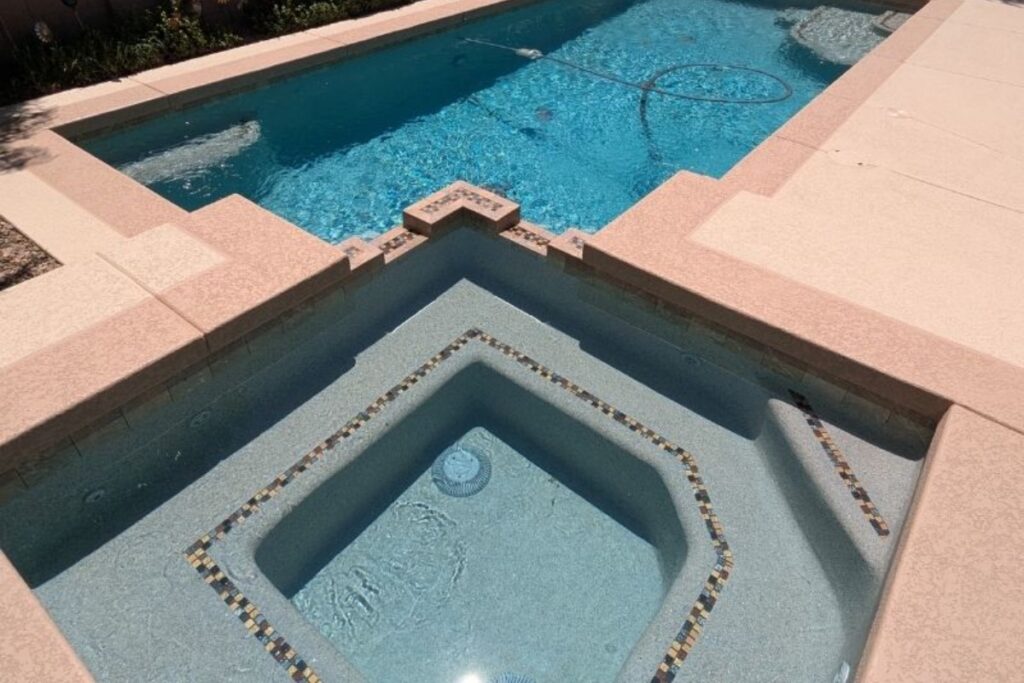
Resurfaced concrete pool deck surface
pool-deck-resurfacing

Pool Deck Resurfacing Scope: What Is and Is Not Included

Almost every unhappy pool deck job we hear about was a scope misunderstanding rather than a workmanship failure. The surface was fine. The owner expected the coping, or the tile, or the furniture, or the planting to be part of it, and it was not. Pool deck resurfacing scope is narrower than most people assume, and the boundary sits in an awkward place, because the things immediately either side of a deck belong to different trades. Here is the line, drawn properly. Pool deck resurfacing scope, item by item Element Normally in scope Whose work it is if not Deck surface Yes Preparation and cleaning of the deck Yes Repairs to the deck slab Yes Joints in the deck, including at the coping Yes Sealer over the new surface Yes Coping stones Usually not Mason or pool builder Waterline tile No Pool builder or tiler Pool interior finish No Pool builder Skimmer, returns, plumbing No Pool service Electrical bonding, lighting, rails wiring No Licensed electrician Screen enclosure and its footings No Enclosure company Fence, gate and latches No Fencing contractor Planting and beds Protection yes, restoration no Owner or gardener Moving and replacing furniture Usually not Owner Refilling and balancing the pool No Pool service What is being bought is on the pool deck resurfacing page, and the sequence the work follows is in what happens on site. What is inside the scope The deck itself, all of it: preparation, removal of delaminated material, repair of spalls and unsound areas, treatment of cracks, treatment of joints including the expansion joint at the coping, the overlay and the sealer. Deck repairs sit under concrete crack repair when they are being done on their own. Protection is in scope too, and it should be stated: the pool covered or the level dropped, the tile line masked, the equipment pad sheeted, the coping protected, planting beds covered, house walls masked. If a proposal is silent on protection, ask, because a crew that has not priced protection has not planned it. Sprayed deck finishes follow exactly the same boundary. The sprayed texture is deck surface and it stops at the coping, like everything else on this list. Coping, and why it is a separate decision Coping is the band of material capping the pool edge, and it does a structural job as well as a visual one. It is masonry, not deck surface, and replacing or resetting it is a different trade with different materials. There is one nuance worth knowing. Cantilevered concrete coping, where the deck concrete itself was formed over the pool edge, is sometimes continuous enough with the deck that an overlay can be carried across it. Stone, brick and precast coping cannot be, and should not be. If your coping is loose, cracked or has stones that rock, that is work to sequence before the deck rather than after, because it disturbs the deck edge. Whatever happens to the coping, the joint between it and the deck is in scope. That joint is the entry route for water going under the slab, and cleaning it out and resealing it is part of the deck work. Anchors, rails and the electrical question Handrail and ladder anchors sit in the deck and the rails usually have to come out for the work. Who removes them, who stores them and who reinstalls them needs settling in advance, and reinstallation is not always as simple as it looks if the anchor is corroded. Then there is bonding. Pool decks have electrical bonding requirements under the National Electrical Code, and equipotential bonding around the pool perimeter is a safety system rather than a finish. A resurfacing overlay generally sits on top of the existing concrete and does not disturb it. But if unsound concrete is being cut out, or anchors are being removed and reset, that is a question for a licensed electrician, and it is a question to ask before the work rather than after it. No deck contractor should be making that call. The screen enclosure, the fence and the gate Screen enclosures sit on footings in or beside the deck. The enclosure is not deck work, the footings are not deck work, and modifying either is somebody else’s job. What is deck work is working around them, masking the frame, and detailing the new surface neatly where it meets each upright. That takes time and it belongs in the quote, which is why the enclosure should be mentioned before the estimator visits rather than discovered by them. Fences, gates and latches are the same. A gate that swung clear over the old surface may not clear a new one if the build up has changed the level at the swing. Raise it early. Steps, and where the texture stops Deck steps up to the house or down to the yard are usually inside the scope if they are part of the deck. Steps into the water are not: those are part of the pool shell. The thing to settle explicitly is where the new texture stops. A change of grip at a step edge is exactly where people fall, so the texture should run continuously through any change of level that is inside the scope, and any point where the new surface meets an old one should be a deliberate detail rather than an accident. That reasoning is in texture and slip resistance. The things around the deck Furniture, planters, umbrella bases and toys are the owner’s to move, before and after. Planting beds against the deck get protected during the work, but restoring anything damaged or overgrown is not deck work. Irrigation heads and low voltage lighting in or beside the deck should be pointed out before sheeting goes down and hides them. Hidden damage found once work starts Preparation reveals things a survey cannot. More delamination than expected is normal and is not a sign of a bad contractor. What matters is that the proposal already says what happens:

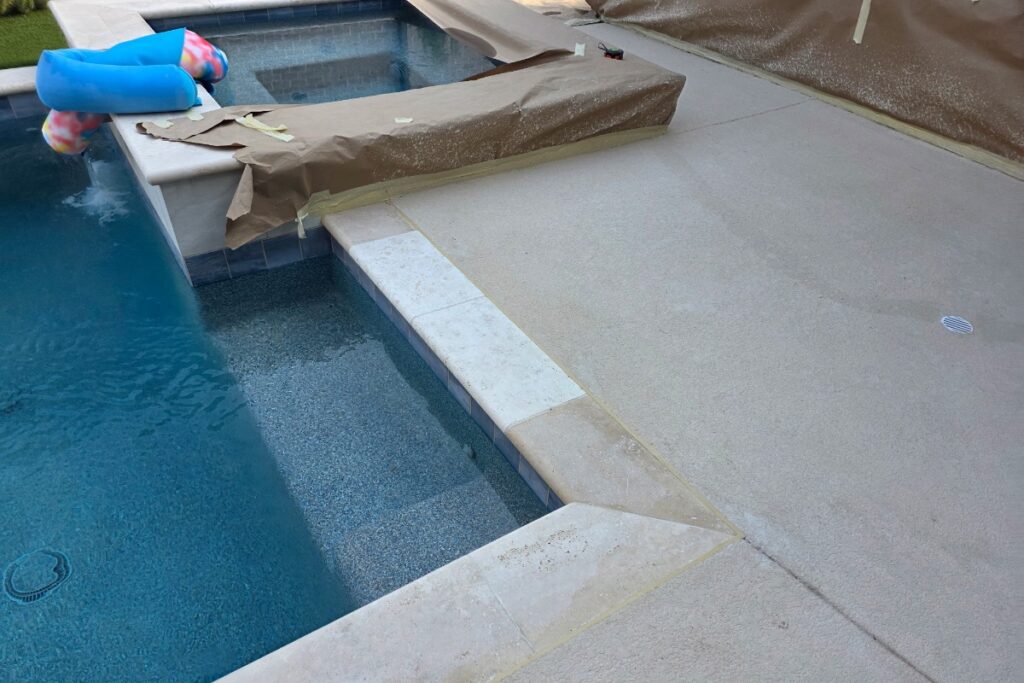
Concrete pool deck overlay beside a swimming pool
pool-deck-resurfacing

Saltwater Pool Deck Coatings: What Salt Actually Does

A saltwater pool deck is not being eaten alive. That is the first thing to say, because the internet has convinced a lot of homeowners that a salt chlorine generator is going to destroy their concrete. It runs at a salinity well below seawater and the water itself is not aggressive. What is happening is slower and more interesting. Salt gets onto the deck, the water evaporates and the salt does not. Every day of the season adds a little more, and three separate mechanisms take it from there. What a saltwater pool deck does differently A chlorine pool puts chlorinated water on the deck. It evaporates and leaves very little behind. A salt pool puts a dilute salt solution on the deck. It evaporates and leaves the salt. Splash out, wet feet, swim toys dropped on the surface and the wet patch where somebody stood to towel off all deliver it. The strip nearest the water gets the most. Then the sun dries the deck and the salt concentrates in and on the surface, ready to be redissolved by the next splash, driven a little deeper each time. Mechanism one: crystals growing inside the concrete Concrete is porous. Salt solution wicks into it. When that water evaporates from inside the pore structure, salt crystals form and grow, and crystal growth exerts real pressure on the pore walls. Repeat that cycle across a season and the pressure fatigues the surface layer from the inside. It is the same mechanism that damages historic masonry in coastal towns, running slowly on a residential deck. When the crystals form on the surface instead of inside it, you get efflorescence, the white bloom that brushes off. Efflorescence itself is cosmetic. What it tells you is not: it means water is moving through the concrete carrying dissolved salt, which is exactly the condition that does the damage under the surface. Mechanism two: salt attacks the surface layer The top few millimetres of a concrete deck are always the weakest part of it, and on many decks weaker still because of how they were finished. Salt exposure accelerates whatever was already going to happen there. The result is surface loss: a sandy feel underfoot, exposed aggregate, shallow pitting. It is the same presentation as any other surface failure, which is why it usually gets misdiagnosed, and it is classified alongside everything else in reading the damage. The repair method is the same as for any other surface loss on exterior concrete: cut back to sound material, fill and grind flush. What salt changes is the speed. Any failure mode that involves a marginal bond runs faster beside a salt pool than beside a chlorine one, so a deck that was prepared badly gives itself away sooner here. Mechanism three: what salt does to the metal in the deck This is the one that produces visible damage fastest, and it is confined to specific places. Handrail anchors, ladder anchors, screen enclosure fixings, anything bolted into the deck: all of these are metal embedded in concrete, often shallowly, often in the splash zone. Chloride reaching that metal breaks down its passive protection and corrosion starts. Corroding steel occupies more volume than the steel it replaces, and that expansion cracks the concrete around it and eventually lifts it. The early sign is a rust stain running away from a fixing. The later sign is a spider of cracks around it. Deal with it at the stain stage and it is a small job. Deal with it at the cracking stage and you are rebuilding the area around the anchor. The splash zone does most of the damage Salt exposure is not evenly distributed and the deck will show you that. The strip closest to the water takes almost all of it, along with the area around the steps where people get in and out, and the ground around the equipment pad where chemicals and salt get spilled during maintenance. If the deck is noticeably worse in those places and sound further back, that gradient is the diagnosis. Uniform damage across the whole deck points at something else, usually drainage, the original finishing, or age. The equipment pad deserves its own attention. Salt is added to the pool in bags, and bags get opened, dragged and spilled on the concrete beside the equipment. That is undiluted salt sitting on a surface that is rarely rinsed and often shaded, which is a far more aggressive exposure than anything the pool itself produces. If you convert an existing chlorine pool to a salt system, that spot is where the first damage usually appears, and it appears within a couple of seasons rather than a decade. What actually helps A dense, sealed surface. The mechanism depends on salt solution getting into the concrete. Reduce the porosity and you reduce the exposure. A properly applied overlay with a maintained sealer does this well. Bare or poorly sealed decorative concrete does it badly. Sealer renewal on schedule. The sealer is the barrier and it is a consumable. Around a salt pool, letting it lapse is not a cosmetic decision. Sealer choice interacts with grip, which is why it is worth reading alongside texture and sealer selection, and it is one of the drivers in what shortens the life of a deck. Rinsing the splash zone. Fresh water at the end of a heavy use day removes salt before it concentrates. It costs nothing and it is the single most effective piece of homeowner maintenance on a salt pool deck. Drainage that works. Run off should carry salt away from the deck rather than pooling on it and evaporating there. A deck that ponds concentrates salt in exactly the places that already stay wet longest. Watching the anchors. Check fixings once a season for rust staining. It is thirty seconds of looking and it catches the fastest moving damage on the deck. Specifying a deck for a salt pool Tell the contractor the pool runs

Textured concrete pool deck resurfacing on a residential pool
pool-deck-resurfacing

Pool Deck Resurfacing Process: What Actually Happens

Homeowners around Cumming and the north Atlanta suburbs usually ask the same two questions in a different order: how long is my pool out of service, and what is actually going to happen to my deck. The pool deck resurfacing process is not complicated, but it runs in a fixed order and every step depends on the one before it holding. Skip one and the failure shows up a season later. This is the whole sequence, from the first walkthrough to the day the furniture goes back, with the points marked where a job quietly goes wrong. If you are still deciding whether the deck needs work at all, start with our pool deck resurfacing page and come back here once you know the answer. The walkthrough that should happen before anyone quotes A quote written from a photograph is a guess. The estimator should be on the deck with a tool in hand, and four things get established before a number exists. Where the slab is hollow. Tapping the deck with a steel rod or dragging a chain across it produces two distinct sounds. A solid ring means the surface is bonded to the slab below. A dull, drummy note means it is not. On a deck that has already been coated or overlaid once, the hollow areas get chalked out, and their total area is the single biggest thing that moves the scope. Hollow surface cannot be built on. It gets cut out and replaced. What the cracks are doing. Hairline surface crazing behaves differently from a crack that runs the full width of the deck and lines up with a control joint. The first is cosmetic. The second is movement, and movement telegraphs through anything laid over it unless it is treated as a joint rather than a defect. Where the water goes. Every deck should shed water away from the pool and away from the house. Standing puddles after rain mean the slope is wrong or a deck drain has silted up, and an overlay follows the shape of what is under it. Resurfacing a deck that ponds gives you a smoother deck that still ponds. What is already on there. Old acrylic texture, a previous overlay, a sprayed Kool Deck finish and bare broom finished concrete all take different preparation. A sprayed texture failing in patches is the trickiest, because how much can be saved is decided by how much still rings solid. Choosing the system happens before the crew arrives Texture, colour and product family are decided at proposal stage, not on the morning of the pour. That matters because the systems have different build thicknesses, different cure schedules and different tolerance for the moisture sitting under a pool deck. Settle all three before the crew is booked, and ask what each choice does to the cure schedule, because that sets how long the deck is out of use. Getting the deck ready The day before work starts, the deck has to be empty. Furniture, planters, umbrella bases and pool toys all move off, and anything that cannot move gets masked. Vehicles come off the driveway if that is the access route, because material and equipment come in that way and dust travels. The pool itself gets protected. The water level is normally dropped below the tile line or the surface is covered, so that grinding dust and washwater do not settle against the tile and into the skimmer. Pump and filter equipment gets sheeted. Planting beds against the deck edge get covered rather than trusted to luck. A screen enclosure changes the job. Masking the frame, working around the footings and getting equipment through one door all take time, and that time belongs in the quote. What the pool deck resurfacing process looks like on a normal week Stage What happens What can hold it up Protection and masking Pool, equipment, coping, tile line, beds and walls covered Screen enclosure, tight access Mechanical preparation Grinding or shot blasting the full deck to open the surface Old coating that has to come off completely Removal and repair Hollow areas cut out, spalls filled, cracks and joints treated More delamination than the survey showed Bond coat Bonding layer over the prepared, clean, damp surface Rain, or a surface that has been left too long and picked up dust Base and texture coats Build coats and the chosen texture worked while workable Heat, wind and humidity, all of which change working time Sealer and cure Sealer applied once the surface has taken its initial set Afternoon storms, dew point overnight Surface preparation decides the outcome This is the step that separates a deck that lasts from one that peels, and it is the step a low bid leaves out. Pressure washing is cleaning, not preparation. It removes dirt. It does not remove the weak surface layer of laitance, old sealer, sunscreen residue or the chalked remains of a previous coating, and it does not create a profile for the new material to key into. Mechanical preparation does. Diamond grinding or shot blasting opens the concrete, takes off what is loose and leaves a measurable texture. Every overlay manufacturer specifies the profile their product needs, and that specification is not a suggestion. On a pool deck there is a second reason for it: years of chlorinated or salt water splashing over the same surface leaves residue that interferes with adhesion, and only mechanical removal gets it off reliably. A properly prepared deck looks uniformly dull, with no glossy patches left anywhere. Repairs and joints go in before the overlay Anything hollow gets cut back to sound concrete and rebuilt. Spalled edges, popped aggregate and pitting get filled and ground flush, and the same repair logic applies here as on any exterior slab: back to sound material, fill, grind flush. Joints are the part most often got wrong. A pool deck has control joints and usually an expansion joint against the coping and against the house. Those

Concrete pool deck overlay showing surface slope to drainage
pool-deck-resurfacing

Pool Deck Drainage: Why Water Sits and How to Fix It

Pool deck drainage is the problem nobody calls about. People call about a slippery patch, a stained corner, a crack that keeps coming back or a surface that failed early. In a large share of those calls the puddle that has been sitting in the same place after every storm for four years turns out to be the cause of all of it. Water that leaves a deck does no harm. Water that stays does all of it. Why this matters more than it looks A saturated concrete surface deteriorates faster than a dry one. The surface layer stays wet for hours longer, cleaning products and pool chemicals stay in contact with it instead of running off, and freeze events, which do happen in north Georgia even if they are brief, do their damage in saturated concrete rather than dry. Then there is what grows. Warm, shaded and permanently damp is ideal for algae and mildew, and that film is the single most common reason a deck becomes slippery years after it was installed. And there is what the water does after it soaks in, which is the part homeowners never see. The surface consequences are scaling, spalling and a slab that never fully dries out between storms, and the connection to service life is in how long the new surface lasts. Find out where the water goes before anyone quotes Wait for real rain rather than using a hose, because a hose creates a puddle where you point it and rain finds the actual low points. When the storm passes and the rest of the deck has dried, walk it and chalk around every remaining puddle. You now have a map. Look at what it tells you. Puddles in one corner point at slope or settlement in that corner. Puddles in a line point at a blocked channel drain. Puddles that appear only in heavy rain but not light rain point at capacity, usually a downspout adding more water than the deck was designed to shed. Puddles right against the coping point at a deck that falls toward the pool, which is both a drainage problem and a water chemistry problem. Pool deck drainage: the four reasons water sits The deck never had enough fall. A deck should shed water away from both the pool and the house. Some are built close to flat, either through error or because the surrounding levels left nowhere for the water to go. That condition has been there since day one and it does not improve. The deck has settled. Far more common on older decks. The base under one area has compacted or washed out, and that section has dropped. The clue is a step at a joint, a crack with a height difference across it, or a puddle that has appeared in a place that used to drain. In this area the usual driver is water getting under the slab through an open joint or a failed coping seal, then carrying the fine material out of the base over several seasons. The drains have stopped working. Channel drains and spot drains silt up. Leaves, sand tracked from the yard, grit off shoes and general debris fill the channel below the grate, and once it is full the drain is decorative. Lift a grate and look. This is the cheapest fix on the list and it is the one most often overlooked. Something was added later. A raised bed built against the deck edge, a retaining wall, a paver path, a screen enclosure kerb or a new patio at a slightly higher level can all block the route water used to take. If ponding started after a project, that project is the first suspect. Where the water goes once it gets under the deck The coping joint is the usual entry point. It is a working expansion joint filled with flexible sealant, that sealant has a service life, and when it fails water runs straight into the gap. Cracks and open control joints do the same job elsewhere on the deck. Under the slab it does two things. It saturates the base, which reduces its bearing capacity, and it moves fine material along with it when it drains away. Both cause settlement, and settlement causes more ponding, which puts more water into the same joint. That is why the problem accelerates: it feeds itself. Sealing the joints and cracks is not cosmetic work, it is what stops the cycle, and it falls under concrete crack repair. What the resulting damage looks like on the surface is set out in reading the damage on your deck. What resurfacing can correct and what it cannot Condition Can an overlay fix it Shallow low spots and minor negative fall Yes. Base coats are built up in the low areas and feathered out. Blocked or silted drains No. Clear them first. An overlay over a dead drain hides the problem. A deck that has settled substantially No. The level difference is too large to build out. Lifting or replacing the section comes first. A whole deck sloping the wrong way No. Correcting that means changing levels, not resurfacing. A downspout discharging on the deck No, and it is the cheapest fix on this page. Extend it. Open joints and failed coping seal Yes, as part of the work. Joints are cleaned out and resealed. Where an overlay is the right answer, slope correction happens in the build up coats rather than the finish coat, which is worth understanding from how the deck gets rebuilt. The service itself is pool deck resurfacing. Getting the timing right Drainage work wants a dry window, and so does any surface work that follows it. That argues against scheduling in the wettest part of the year, and it argues strongly against doing the surface before the drainage, because the first heavy storm will tell you whether the fix worked. Seasonal detail is on the best time of year to resurface

Repaired and resurfaced concrete pool deck surface
pool-deck-resurfacing

Pool Deck Repair: Reading Cracks, Spalls and Hollows

Most people call about pool deck repair after the deck has been telling them something for two or three seasons. The useful skill is reading what the damage is, because the same deck can need a morning of patching or a full resurfacing depending on which of five things is actually happening. Here is how to classify what you are looking at before anyone quotes on it, and what each category genuinely needs. Cracks, and what each type is telling you Map crazing. A fine, shallow network of lines across the surface, like a dried lakebed at a small scale. It comes from the surface drying faster than the concrete underneath during the original finishing. It is cosmetic, it does not go deep, and an overlay covers it permanently. Shrinkage cracks. Thin cracks that wander, usually well under the width of a pencil line, that appeared in the first year of the deck’s life and have not changed since. They are stable. They get filled and they stay filled. Control joint cracks. A crack that runs dead straight and lines up with a saw cut, or that runs between two joints as if it were completing a line. That is the slab doing exactly what the joints were cut for, in a place where the joint was too shallow or spaced too far apart. This is not a defect to fill. It is a joint that has to be respected in any new surface. Movement cracks. A crack with a height difference across it, or one that opens and closes with the seasons, or one that is wider at one end. That is the ground moving under the slab. In the north Atlanta suburbs that usually means water getting under the deck and washing fines out of the base, or clay soil swelling and shrinking with the wet and dry cycle. Filling it changes nothing. The cause has to be dealt with first, which usually starts with standing water on the deck and where it goes. If cracking is all you have and the slab is otherwise sound, that is straightforward concrete crack repair and nothing more. Spalling, scaling and popouts Spalling is the loss of the concrete surface itself, leaving exposed aggregate and a rough, sandy feel underfoot. Around a pool it has causes a driveway does not share. A weak surface layer from the original pour is the most common. If the finishers worked water into the surface to make troweling easier, the top few millimetres end up with too much water and too little cement, and that layer eventually gives up. It shows as broad, shallow, even loss rather than sharp pits. Repeated wetting is the second. A deck that never fully dries, because it is shaded, badly drained or in the splash zone all summer, stays saturated, and saturated concrete surfaces deteriorate faster. Chemical exposure is the third. Splash out from a chlorinated or salt pool, spilled chemicals near the equipment pad and aggressive cleaning products all attack the surface over time. Popouts, which are small sharp craters with a piece of aggregate at the bottom, are a different thing again: a reactive or porous stone near the surface that expanded and blew the concrete off above it. They are isolated and cosmetic. All three are surface repairs rather than structural ones, and they are fixed the same way: cut back to sound concrete, fill, and grind flush. Hollow spots are the one that changes the whole job Tap the deck with the handle of a screwdriver or drag a short length of chain across it. A bonded surface rings. A delaminated one gives a dull, drummy knock. Walk the whole deck doing it and mark every dull area with chalk, and you will have a map that tells you more than any photograph. Hollow means the top layer, whether that is a previous overlay, a sprayed texture or the original troweled surface, has separated from the concrete below. It is the single most important thing to establish, because nothing can be built on a delaminated surface. Those areas get cut out and rebuilt before any new material goes down. On sprayed finishes the pattern is often worst near the edges and around the coping, where water gets in underneath. How much of a failing sprayed deck can be saved depends almost entirely on how much of it still rings solid, which is why the sounding survey decides the scope rather than the appearance does. Coping, the bond beam and the joint nobody maintains The joint between the coping stones and the deck is a working expansion joint. The deck moves, the pool shell does not move with it, and that joint absorbs the difference. It is filled with a flexible sealant and that sealant has a service life measured in years, not decades. When it fails, water runs straight into the gap. It gets under the deck, it saturates the base, and over enough seasons it carries fines away and leaves a void. Loose or rocking coping stones, a crack running parallel to the pool a hand’s width back from the edge, and a deck edge that has dropped relative to the coping are all downstream of that one failed joint. This is the cheapest maintenance on a pool deck and the most commonly skipped. Standing water is a cause, not a symptom A deck that holds puddles after rain is feeding every other problem on this page. Water sitting on the surface accelerates surface loss, keeps the slab saturated, finds its way into cracks and joints, and grows the algae film that makes a deck slippery. Before repairing anything, find out where the water goes and why it stops where it does. Pool deck repair, matched to what you found What you have What it needs Map crazing only Nothing structural. Covered by an overlay when you are ready. Stable hairline cracks Fill and move on, or overlay. Cracks on joint lines Treat

Scroll to Top