
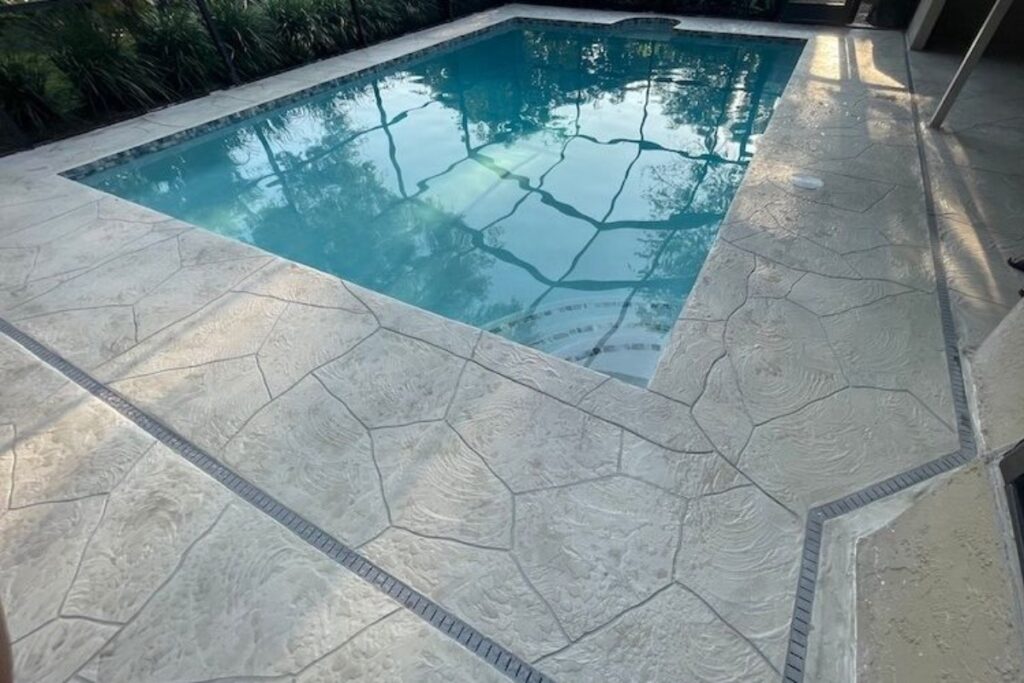
Homeowners around Cumming and the north Atlanta suburbs usually ask the same two questions in a different order: how long is my pool out of service, and what is actually going to happen to my deck. The pool deck resurfacing process is not complicated, but it runs in a fixed order and every step depends on the one before it holding. Skip one and the failure shows up a season later.
This is the whole sequence, from the first walkthrough to the day the furniture goes back, with the points marked where a job quietly goes wrong. If you are still deciding whether the deck needs work at all, start with our pool deck resurfacing page and come back here once you know the answer.
The walkthrough that should happen before anyone quotes
A quote written from a photograph is a guess. The estimator should be on the deck with a tool in hand, and four things get established before a number exists.
Where the slab is hollow. Tapping the deck with a steel rod or dragging a chain across it produces two distinct sounds. A solid ring means the surface is bonded to the slab below. A dull, drummy note means it is not. On a deck that has already been coated or overlaid once, the hollow areas get chalked out, and their total area is the single biggest thing that moves the scope. Hollow surface cannot be built on. It gets cut out and replaced.
What the cracks are doing. Hairline surface crazing behaves differently from a crack that runs the full width of the deck and lines up with a control joint. The first is cosmetic. The second is movement, and movement telegraphs through anything laid over it unless it is treated as a joint rather than a defect.
Where the water goes. Every deck should shed water away from the pool and away from the house. Standing puddles after rain mean the slope is wrong or a deck drain has silted up, and an overlay follows the shape of what is under it. Resurfacing a deck that ponds gives you a smoother deck that still ponds.
What is already on there. Old acrylic texture, a previous overlay, a sprayed Kool Deck finish and bare broom finished concrete all take different preparation. A sprayed texture failing in patches is the trickiest, because how much can be saved is decided by how much still rings solid.
Choosing the system happens before the crew arrives
Texture, colour and product family are decided at proposal stage, not on the morning of the pour. That matters because the systems have different build thicknesses, different cure schedules and different tolerance for the moisture sitting under a pool deck. Settle all three before the crew is booked, and ask what each choice does to the cure schedule, because that sets how long the deck is out of use.
Getting the deck ready
The day before work starts, the deck has to be empty. Furniture, planters, umbrella bases and pool toys all move off, and anything that cannot move gets masked. Vehicles come off the driveway if that is the access route, because material and equipment come in that way and dust travels.
The pool itself gets protected. The water level is normally dropped below the tile line or the surface is covered, so that grinding dust and washwater do not settle against the tile and into the skimmer. Pump and filter equipment gets sheeted. Planting beds against the deck edge get covered rather than trusted to luck.
A screen enclosure changes the job. Masking the frame, working around the footings and getting equipment through one door all take time, and that time belongs in the quote.
What the pool deck resurfacing process looks like on a normal week
| Stage | What happens | What can hold it up |
|---|---|---|
| Protection and masking | Pool, equipment, coping, tile line, beds and walls covered | Screen enclosure, tight access |
| Mechanical preparation | Grinding or shot blasting the full deck to open the surface | Old coating that has to come off completely |
| Removal and repair | Hollow areas cut out, spalls filled, cracks and joints treated | More delamination than the survey showed |
| Bond coat | Bonding layer over the prepared, clean, damp surface | Rain, or a surface that has been left too long and picked up dust |
| Base and texture coats | Build coats and the chosen texture worked while workable | Heat, wind and humidity, all of which change working time |
| Sealer and cure | Sealer applied once the surface has taken its initial set | Afternoon storms, dew point overnight |
Surface preparation decides the outcome
This is the step that separates a deck that lasts from one that peels, and it is the step a low bid leaves out. Pressure washing is cleaning, not preparation. It removes dirt. It does not remove the weak surface layer of laitance, old sealer, sunscreen residue or the chalked remains of a previous coating, and it does not create a profile for the new material to key into.
Mechanical preparation does. Diamond grinding or shot blasting opens the concrete, takes off what is loose and leaves a measurable texture. Every overlay manufacturer specifies the profile their product needs, and that specification is not a suggestion. On a pool deck there is a second reason for it: years of chlorinated or salt water splashing over the same surface leaves residue that interferes with adhesion, and only mechanical removal gets it off reliably.
A properly prepared deck looks uniformly dull, with no glossy patches left anywhere.
Repairs and joints go in before the overlay
Anything hollow gets cut back to sound concrete and rebuilt. Spalled edges, popped aggregate and pitting get filled and ground flush, and the same repair logic applies here as on any exterior slab: back to sound material, fill, grind flush.
Joints are the part most often got wrong. A pool deck has control joints and usually an expansion joint against the coping and against the house. Those joints exist because the slab moves. An overlay poured straight across them will crack along the line of every one of them within a season, and the crack will look worse than the joint it hid. The joints get carried up through the new surface, cut clean and filled with a flexible sealant. A finished deck should still show its joints.
Bond coat, base coat, texture coat
The bond coat goes onto a clean, prepared, usually damp surface and it is the mechanical and chemical link between old concrete and new material. It is applied to an area the crew can cover before it skins over, which is why you see the deck done in sections with a wet edge rather than all at once.
Base coats build thickness and level out the surface. The texture coat gives the deck its final look and its slip resistance, and it is worked by hand while it is still open: knocked down with a trowel, broomed, or sprayed and knocked back depending on the finish chosen. This is skilled, time sensitive work, and heat shortens the window. In a north Georgia July the crew is chasing the material.
Sealer, cure and getting back in the water
Sealer goes on once the surface has taken its set, and it does two jobs: it protects the colour from ultraviolet light and pool chemicals, and it makes the deck cleanable. It is also the layer that will need renewing periodically, long before the overlay itself needs anything.
Curing is not drying. The material continues to gain strength after it stops feeling wet, and load applied too early leaves marks that do not come out. Light foot traffic usually comes first. Furniture, planters and anything with narrow feet waits longer. In humid weather everything waits longer still, because the surface gives up moisture more slowly.
North Georgia weather moves the schedule
Summer here brings afternoon storms that arrive fast, and a deck with fresh material on it does not tolerate rain. Crews start early and stop early through July and August for exactly that reason. Spring brings pollen, which will settle into a wet surface and stay there. Late autumn brings cool nights, and overnight temperatures below the product minimum stop the cure rather than slowing it.
None of that makes any season impossible. It makes the schedule honest. We go into the seasonal detail on the best time of year to resurface concrete in Georgia.
What a good proposal contains
It should name the preparation method, not just say the deck will be prepared. It should state the measured or estimated area of hollow surface to be removed and what happens if more is found. It should say how joints are treated. It should name the system and the sealer. And it should give two separate return to service times, one for foot traffic and one for furniture.
If a proposal is missing the preparation method and the joint treatment, those are the two places the money was saved. More on vetting is in our guide to choosing a pool deck resurfacing contractor. The same sequence applies to patios, walkways and porches under resurfacing, with finish ideas on patio resurfacing ideas around Atlanta. Short answers are in answers to the questions we get most.
Frequently asked questions
How long does pool deck resurfacing take?
For a typical residential deck, plan on three to five working days on site for a straightforward overlay, and longer if there is significant repair or a large area of delamination to cut out. The pool itself is usually usable again before the deck is, because the surface needs its full cure before furniture and heavy traffic go back on it.
Do I have to drain the pool to resurface the deck?
Usually not. The water level is normally dropped below the tile line or covered so that dust and washwater do not sit against the tile, and the pool is protected while the deck is prepared. Draining is only needed when the coping is being reset or when work extends onto the bond beam.
Can you resurface over an old pool deck coating?
Only if the old coating is well bonded across the whole deck. Any coating that sounds hollow, chalks off in your hand or lifts at the edges has to come off, because a new overlay is only as sound as the layer it sits on. That is what the sounding survey at the start of the job is for.
What preparation do I need to do before the crew arrives?
Clear furniture, planters and toys off the deck, move vehicles away from the access route, and let us know where the water and power connections are. If there is a screen enclosure, tell us before the quote so masking and access are priced in rather than becoming a surprise.
When can I walk on the deck and put the furniture back?
Light foot traffic is usually possible within a day of the final coat in good conditions. Furniture, planters and anything with feet that concentrate load should wait until the sealer has fully cured, which is longer in humid weather. Your installer should give you both numbers in writing, not just one.