
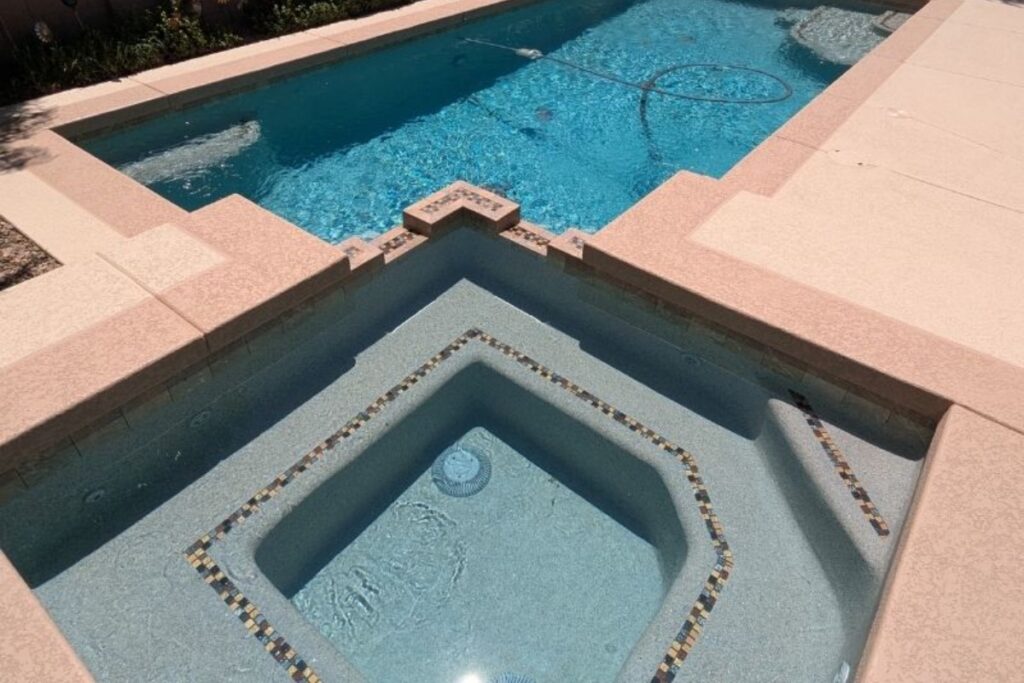
Pool deck drainage is the problem nobody calls about. People call about a slippery patch, a stained corner, a crack that keeps coming back or a surface that failed early. In a large share of those calls the puddle that has been sitting in the same place after every storm for four years turns out to be the cause of all of it.
Water that leaves a deck does no harm. Water that stays does all of it.
Why this matters more than it looks
A saturated concrete surface deteriorates faster than a dry one. The surface layer stays wet for hours longer, cleaning products and pool chemicals stay in contact with it instead of running off, and freeze events, which do happen in north Georgia even if they are brief, do their damage in saturated concrete rather than dry.
Then there is what grows. Warm, shaded and permanently damp is ideal for algae and mildew, and that film is the single most common reason a deck becomes slippery years after it was installed. And there is what the water does after it soaks in, which is the part homeowners never see. The surface consequences are scaling, spalling and a slab that never fully dries out between storms, and the connection to service life is in how long the new surface lasts.
Find out where the water goes before anyone quotes
Wait for real rain rather than using a hose, because a hose creates a puddle where you point it and rain finds the actual low points. When the storm passes and the rest of the deck has dried, walk it and chalk around every remaining puddle.
You now have a map. Look at what it tells you. Puddles in one corner point at slope or settlement in that corner. Puddles in a line point at a blocked channel drain. Puddles that appear only in heavy rain but not light rain point at capacity, usually a downspout adding more water than the deck was designed to shed. Puddles right against the coping point at a deck that falls toward the pool, which is both a drainage problem and a water chemistry problem.
Pool deck drainage: the four reasons water sits
The deck never had enough fall. A deck should shed water away from both the pool and the house. Some are built close to flat, either through error or because the surrounding levels left nowhere for the water to go. That condition has been there since day one and it does not improve.
The deck has settled. Far more common on older decks. The base under one area has compacted or washed out, and that section has dropped. The clue is a step at a joint, a crack with a height difference across it, or a puddle that has appeared in a place that used to drain. In this area the usual driver is water getting under the slab through an open joint or a failed coping seal, then carrying the fine material out of the base over several seasons.
The drains have stopped working. Channel drains and spot drains silt up. Leaves, sand tracked from the yard, grit off shoes and general debris fill the channel below the grate, and once it is full the drain is decorative. Lift a grate and look. This is the cheapest fix on the list and it is the one most often overlooked.
Something was added later. A raised bed built against the deck edge, a retaining wall, a paver path, a screen enclosure kerb or a new patio at a slightly higher level can all block the route water used to take. If ponding started after a project, that project is the first suspect.
Where the water goes once it gets under the deck
The coping joint is the usual entry point. It is a working expansion joint filled with flexible sealant, that sealant has a service life, and when it fails water runs straight into the gap. Cracks and open control joints do the same job elsewhere on the deck.
Under the slab it does two things. It saturates the base, which reduces its bearing capacity, and it moves fine material along with it when it drains away. Both cause settlement, and settlement causes more ponding, which puts more water into the same joint. That is why the problem accelerates: it feeds itself. Sealing the joints and cracks is not cosmetic work, it is what stops the cycle, and it falls under concrete crack repair. What the resulting damage looks like on the surface is set out in reading the damage on your deck.
What resurfacing can correct and what it cannot
| Condition | Can an overlay fix it |
|---|---|
| Shallow low spots and minor negative fall | Yes. Base coats are built up in the low areas and feathered out. |
| Blocked or silted drains | No. Clear them first. An overlay over a dead drain hides the problem. |
| A deck that has settled substantially | No. The level difference is too large to build out. Lifting or replacing the section comes first. |
| A whole deck sloping the wrong way | No. Correcting that means changing levels, not resurfacing. |
| A downspout discharging on the deck | No, and it is the cheapest fix on this page. Extend it. |
| Open joints and failed coping seal | Yes, as part of the work. Joints are cleaned out and resealed. |
Where an overlay is the right answer, slope correction happens in the build up coats rather than the finish coat, which is worth understanding from how the deck gets rebuilt. The service itself is pool deck resurfacing.
Getting the timing right
Drainage work wants a dry window, and so does any surface work that follows it. That argues against scheduling in the wettest part of the year, and it argues strongly against doing the surface before the drainage, because the first heavy storm will tell you whether the fix worked. Seasonal detail is on the best time of year to resurface concrete in Georgia, and where the deck runs into a patio or walkway the same considerations apply across the whole area under resurfacing.
Fix the water first. It is the cheapest thing on the list and it decides how everything after it performs.
Frequently asked questions
Is standing water on a pool deck a serious problem?
It is more serious than it looks. Water sitting on the surface keeps the concrete saturated, works into joints and edges, feeds the algae film that makes decks slippery, and over enough seasons undermines the base under the slab. A deck that ponds is aging considerably faster than one that drains, whatever surface is on it.
Can resurfacing fix a pool deck that holds water?
It can correct minor slope, because the base coats can be built up in the low areas and feathered out. It cannot correct a deck that has settled substantially, a blocked or missing drain, or a slope that runs the wrong way across the whole deck. Those are dealt with first, and then the surface goes on.
How do I find out why water sits on my deck?
Wait for rain, then chalk around each puddle once the surrounding deck has dried. That gives you a map of the low points. Then check the obvious causes in order: blocked deck drains, a downspout discharging nearby, a hardscape or bed edge added later that blocks the run off, and any area where the deck has visibly dropped relative to the coping or the house.
Do pool decks need drains?
Not always. A deck with enough fall to shed water clear of the pool and the house may not need any. Drains become necessary where the deck is enclosed, where it sits below the surrounding ground, or where the fall has nowhere to go. If drains exist, they only work when they are clear, and silted channel drains are one of the most common causes of ponding on an older deck.
Who fixes standing water around a pool, a concrete contractor or a plumber?
It depends on the cause. Slope, settlement and slab related problems are concrete work. A blocked underground line running from a deck drain is drainage work. The first step is establishing which one you have, because paying the wrong trade to look at it is the expensive route to the same answer.