
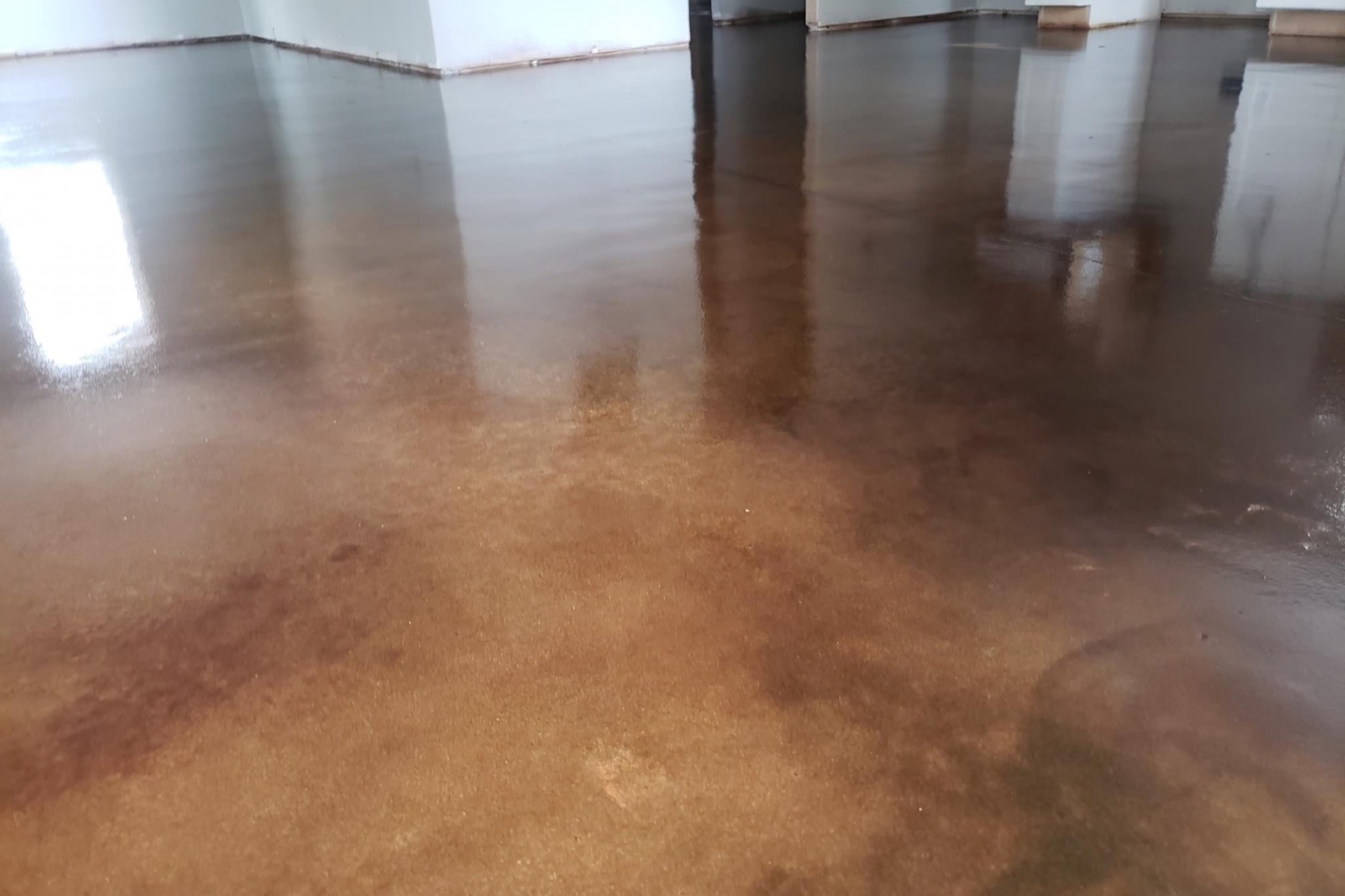
Post-tensioned slabs are common in parking structures, elevated decks, commercial buildings and a great many homes built in recent decades. For a floor coating or a slab repair, post-tensioning changes a few specific things and leaves most of the process untouched. Knowing which is which prevents both unnecessary worry and one genuinely serious mistake.
What a post-tension slab is
Steel strands run through the slab inside plastic sheathing, laid out in a grid before the pour. Once the concrete has gained strength, those strands are tensioned with a hydraulic jack and anchored at the slab edge, putting the concrete into compression.
That compression is what allows longer spans, thinner slabs and better crack control. It also means the strands remain under very high tension for the life of the structure, and that single fact governs everything below.
Identifying one before work starts
- Look for markings. Many slabs carry a plaque or a stamp, commonly near an entrance, an electrical panel or at a slab edge, warning against cutting or drilling.
- Look at the slab edge. Anchorage pockets, patched with grout, appear at the perimeter at regular intervals. They are frequently visible once you know to look.
- Ask for the drawings. The original tendon layout drawings may exist with the builder, the owner or the engineer of record, and they are worth finding before any penetration is contemplated.
- Scan when in doubt. Ground penetrating radar or similar scanning locates tendons quickly and inexpensively relative to the consequence of hitting one.
Assuming a slab is conventionally reinforced because nobody said otherwise is not a method.
The one rule that is not negotiable
Do not drill, cut or core into a post-tension slab without knowing where the tendons are. A cut tendon releases its tension suddenly. That is a safety hazard to whoever is doing the work, and it is structural damage that is expensive and difficult to repair. For a coating or repair project this matters in a defined set of situations, and each is avoidable with planning:
- Anchoring equipment, racking, bollards, handrails or machinery into the slab.
- Coring for a drain, a sleeve or a conduit.
- Saw cutting for a trench drain or a new joint.
- Setting dowels or anchors as part of a slab repair.
- Removing damaged concrete to depth, which is the one that catches people out.
That last point deserves attention. A repair that begins as a surface patch can extend deeper than expected once unsound material is removed, and at some depth the question changes from a repair to a structural one.
What does not change at all
Most of a coating project is unaffected, and it is worth naming the parts so the constraint does not expand to fill the whole job.
- Surface preparation is identical. Diamond grinding or shot blasting to an appropriate profile stays in the top fraction of a millimeter and comes nowhere near the tendons. The principle is in epoxy garage floor coating, how surface preparation determines long-term results.
- Moisture testing is the same requirement, covered in concrete floor treatment options for moisture-prone environments.
- Surface crack filling and patching is the same work, since routing and filling a crack stays in the top few millimeters.
- System selection is decided by the use of the space rather than by the slab’s reinforcement.
So the honest summary is that post-tension is a constraint on penetrations and on depth of removal, rather than a different flooring process.
Cracks in a post-tension slab
They crack. Tensioning reduces cracking rather than eliminating it, and a hairline crack in a post-tensioned slab is not automatically a structural concern.
What matters is movement rather than presence. A tight crack with both sides at the same height, not growing over time, is a candidate for routing, filling and coating over. A crack with vertical displacement, or one that opens and closes seasonally, indicates movement, and no coating bridges movement. The assessment is covered in concrete crack repair, cosmetic versus structural.
One point is specific to post-tension. A crack that is wide, that shows displacement, or that appears near a slab edge where the anchorages are, deserves an engineer’s opinion rather than a contractor’s. That opinion costs very little against the alternative.
The slab edge and the anchor pockets
Tendons are anchored at the perimeter, and during construction those anchorages sit in recessed pockets later patched with grout. Those patches are part of the finished slab whether anyone thinks about them or not.
Two consequences follow. The patches are a different material from the surrounding concrete and can read differently under a coating, particularly a clear or lightly pigmented one. And a deteriorated pocket patch is a repair to make properly rather than to coat over, and the repair must not disturb the anchorage.
On exposed parking decks this matters more, because water reaching an anchorage is a corrosion problem rather than a cosmetic one. The related protection is discussed in anti-corrosion concrete treatment for parking decks and exterior slabs.
Parking decks and elevated slabs
A great many post-tensioned slabs are parking structures, and those bring additional considerations. Water and chloride management is the dominant issue, since corrosion of embedded steel is what takes these structures out of service. Traffic coatings, drainage and joint sealing are the defenses, and they are covered in protecting surfaces and ensuring safety with traffic coatings. Any repair on an elevated post-tensioned slab is engineering territory rather than a contractor decision, because the structure is carrying load and the tendons are part of how it does so.
What to establish before the project starts
Whether the slab is post-tensioned, and how that was confirmed. Whether tendon layout drawings exist. Whether anything is being anchored into the floor, now or later. Whether any coring, saw cutting or trenching is contemplated. The expected depth of removal for repairs, and what happens if it turns out to be deeper. And who the engineer of record is, for anything beyond the surface.
Answering those before mobilization is the difference between a routine project and a stoppage. Our restoration work is on the concrete slab restoration and concrete crack repair pages.
Frequently asked questions
How do I know if a slab is post-tensioned?
Look for a plaque or stamp warning against cutting or drilling, commonly near an entrance, an electrical panel or a slab edge. Look at the perimeter for grout-patched anchorage pockets at regular intervals. Ask for the original tendon layout drawings. Where there is any doubt, scanning locates tendons quickly and cheaply relative to the consequence of hitting one.
Can a post-tension slab be ground for a coating?
Yes. Diamond grinding and shot blasting remove a fraction of a millimeter to create a bonding profile, and the tendons sit well within the slab, far below that. Surface preparation is unchanged. What changes is anything penetrating the slab, and anything removing concrete to depth during a repair.
What happens if a tendon is cut?
It releases its tension suddenly, which is a serious hazard to anyone working nearby and structural damage that is expensive and difficult to repair. That is why locating tendons before any penetration is a requirement rather than a precaution, and why depth of removal during a repair needs establishing in advance rather than discovering mid-job.
Do post-tension slabs crack?
Yes. Tensioning reduces cracking rather than eliminating it, and a tight hairline crack is not automatically a structural concern. What matters is whether it moves: both sides level and no growth over time means it can be routed, filled and coated over. Displacement or seasonal movement means the slab is moving, and no coating bridges movement.
Can we anchor racking or equipment to a post-tension floor?
Only after the tendons have been located, which is a reason to scan rather than a reason to avoid anchoring. Plan the anchor positions against the tendon layout before the floor work begins. If anchoring is likely later, say so at the quoting stage, because planning for it is far easier than retrofitting around it.