
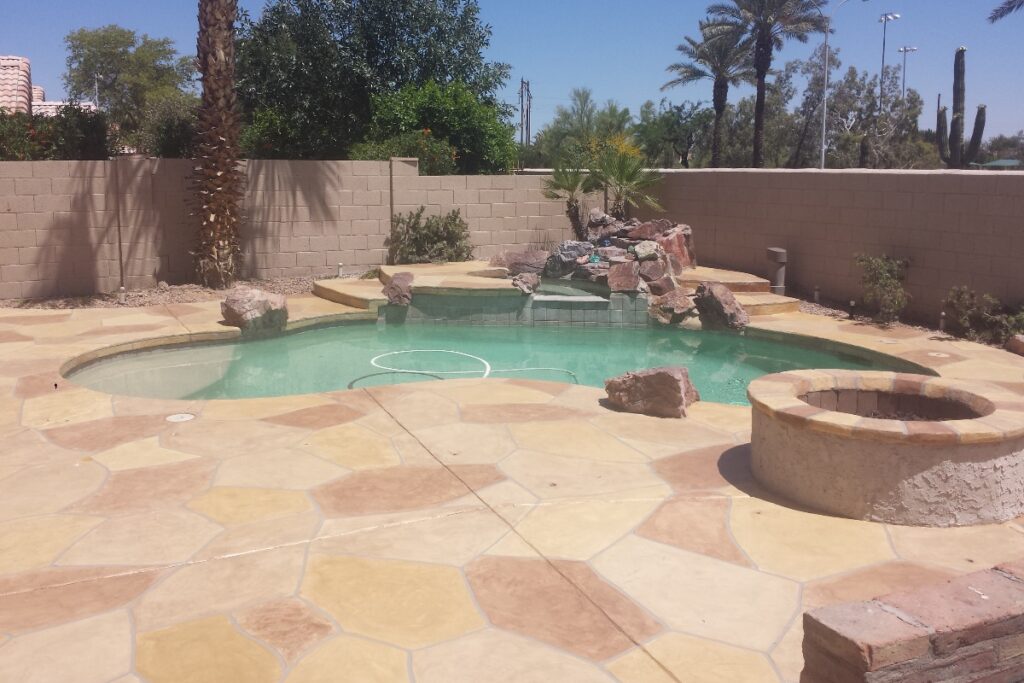
A saltwater pool deck is not being eaten alive. That is the first thing to say, because the internet has convinced a lot of homeowners that a salt chlorine generator is going to destroy their concrete. It runs at a salinity well below seawater and the water itself is not aggressive.
What is happening is slower and more interesting. Salt gets onto the deck, the water evaporates and the salt does not. Every day of the season adds a little more, and three separate mechanisms take it from there.
What a saltwater pool deck does differently
A chlorine pool puts chlorinated water on the deck. It evaporates and leaves very little behind. A salt pool puts a dilute salt solution on the deck. It evaporates and leaves the salt.
Splash out, wet feet, swim toys dropped on the surface and the wet patch where somebody stood to towel off all deliver it. The strip nearest the water gets the most. Then the sun dries the deck and the salt concentrates in and on the surface, ready to be redissolved by the next splash, driven a little deeper each time.
Mechanism one: crystals growing inside the concrete
Concrete is porous. Salt solution wicks into it. When that water evaporates from inside the pore structure, salt crystals form and grow, and crystal growth exerts real pressure on the pore walls.
Repeat that cycle across a season and the pressure fatigues the surface layer from the inside. It is the same mechanism that damages historic masonry in coastal towns, running slowly on a residential deck. When the crystals form on the surface instead of inside it, you get efflorescence, the white bloom that brushes off. Efflorescence itself is cosmetic. What it tells you is not: it means water is moving through the concrete carrying dissolved salt, which is exactly the condition that does the damage under the surface.
Mechanism two: salt attacks the surface layer
The top few millimetres of a concrete deck are always the weakest part of it, and on many decks weaker still because of how they were finished. Salt exposure accelerates whatever was already going to happen there.
The result is surface loss: a sandy feel underfoot, exposed aggregate, shallow pitting. It is the same presentation as any other surface failure, which is why it usually gets misdiagnosed, and it is classified alongside everything else in reading the damage. The repair method is the same as for any other surface loss on exterior concrete: cut back to sound material, fill and grind flush. What salt changes is the speed. Any failure mode that involves a marginal bond runs faster beside a salt pool than beside a chlorine one, so a deck that was prepared badly gives itself away sooner here.
Mechanism three: what salt does to the metal in the deck
This is the one that produces visible damage fastest, and it is confined to specific places.
Handrail anchors, ladder anchors, screen enclosure fixings, anything bolted into the deck: all of these are metal embedded in concrete, often shallowly, often in the splash zone. Chloride reaching that metal breaks down its passive protection and corrosion starts. Corroding steel occupies more volume than the steel it replaces, and that expansion cracks the concrete around it and eventually lifts it.
The early sign is a rust stain running away from a fixing. The later sign is a spider of cracks around it. Deal with it at the stain stage and it is a small job. Deal with it at the cracking stage and you are rebuilding the area around the anchor.
The splash zone does most of the damage
Salt exposure is not evenly distributed and the deck will show you that. The strip closest to the water takes almost all of it, along with the area around the steps where people get in and out, and the ground around the equipment pad where chemicals and salt get spilled during maintenance.
If the deck is noticeably worse in those places and sound further back, that gradient is the diagnosis. Uniform damage across the whole deck points at something else, usually drainage, the original finishing, or age.
The equipment pad deserves its own attention. Salt is added to the pool in bags, and bags get opened, dragged and spilled on the concrete beside the equipment. That is undiluted salt sitting on a surface that is rarely rinsed and often shaded, which is a far more aggressive exposure than anything the pool itself produces. If you convert an existing chlorine pool to a salt system, that spot is where the first damage usually appears, and it appears within a couple of seasons rather than a decade.
What actually helps
A dense, sealed surface. The mechanism depends on salt solution getting into the concrete. Reduce the porosity and you reduce the exposure. A properly applied overlay with a maintained sealer does this well. Bare or poorly sealed decorative concrete does it badly.
Sealer renewal on schedule. The sealer is the barrier and it is a consumable. Around a salt pool, letting it lapse is not a cosmetic decision. Sealer choice interacts with grip, which is why it is worth reading alongside texture and sealer selection, and it is one of the drivers in what shortens the life of a deck.
Rinsing the splash zone. Fresh water at the end of a heavy use day removes salt before it concentrates. It costs nothing and it is the single most effective piece of homeowner maintenance on a salt pool deck.
Drainage that works. Run off should carry salt away from the deck rather than pooling on it and evaporating there. A deck that ponds concentrates salt in exactly the places that already stay wet longest.
Watching the anchors. Check fixings once a season for rust staining. It is thirty seconds of looking and it catches the fastest moving damage on the deck.
Specifying a deck for a salt pool
Tell the contractor the pool runs on salt before they quote, and expect it to affect the specification rather than just the price. Ask which system they would put on a salt pool and why. Ask what sealer goes over it and how often it needs renewing in that exposure. Ask how the fixings and the coping joint are detailed, because those are the entry points.
For the installed work see pool deck resurfacing, and where salt is being tracked onto adjoining patios and walkways as well, those are quoted under resurfacing. The short answers to what people ask most about salt pools and decking are in answers to the questions we get most.
Frequently asked questions
Does a saltwater pool damage a concrete deck?
Over time, yes, though not in the dramatic way people expect. A salt chlorine generator runs at a salinity far below seawater, so the deck is not being corroded quickly. What happens instead is slow and cumulative: salt is carried onto the deck by splash and wet feet, the water evaporates, and the salt stays behind and concentrates. That cycle repeats every day of the season.
Do saltwater pools need a different deck coating?
They need a coating that is dense, well sealed and maintained, rather than a special product category. Porous surfaces and unsealed decorative concrete do worst, because salt solution can enter and crystallise inside the pore structure. A dense overlay with a sealer that is renewed on schedule handles salt exposure well.
What is the white powder on my pool deck?
Almost certainly efflorescence: salts carried to the surface in solution and left behind when the water evaporates. It is mostly cosmetic and it brushes or washes off. It is worth paying attention to, because it tells you that water is moving through the concrete and depositing salt, which is the same mechanism that causes damage below the surface.
Should I rinse my pool deck if I have a salt pool?
Rinsing the splash zone with fresh water at the end of a heavy use day is genuinely useful and costs nothing. It removes salt before it concentrates. It matters most in the strip nearest the water, on any deck that is not shaded, and around the equipment pad where spills happen.
Will a salt system corrode the metal in my pool deck?
It can, where metal is embedded shallowly in the concrete. Handrail anchors, ladder anchors and screen enclosure fixings are the usual sites. Corroding steel expands, and that expansion cracks and lifts the concrete around it. Rust staining running from a fixing is the early warning, and it is worth acting on before the concrete around it starts to break up.