
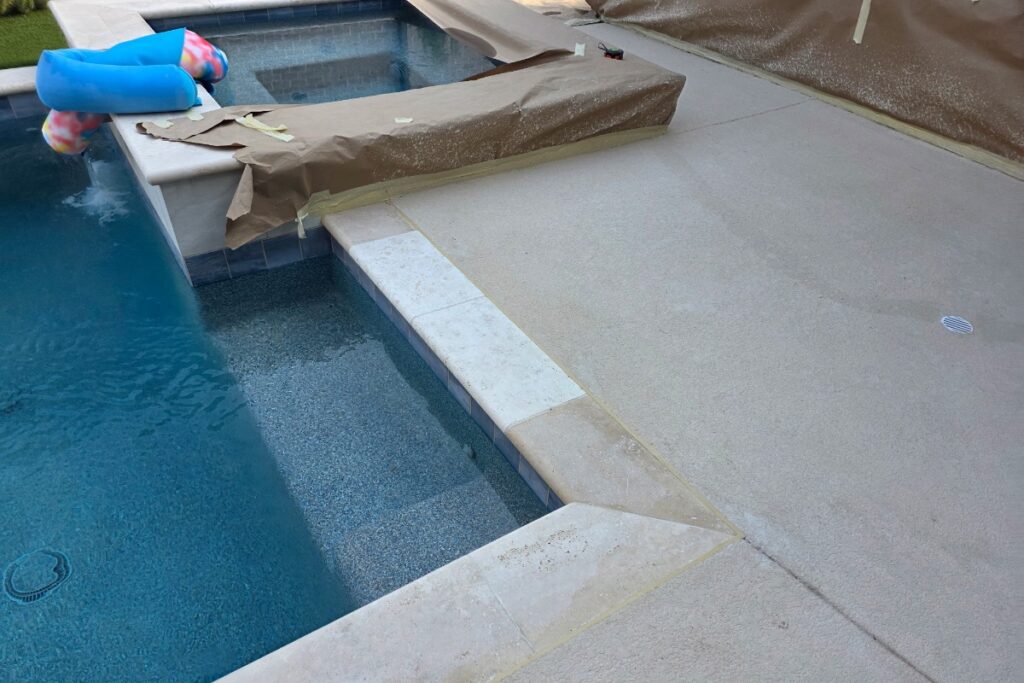
Most people call about pool deck repair after the deck has been telling them something for two or three seasons. The useful skill is reading what the damage is, because the same deck can need a morning of patching or a full resurfacing depending on which of five things is actually happening.
Here is how to classify what you are looking at before anyone quotes on it, and what each category genuinely needs.
Cracks, and what each type is telling you
Map crazing. A fine, shallow network of lines across the surface, like a dried lakebed at a small scale. It comes from the surface drying faster than the concrete underneath during the original finishing. It is cosmetic, it does not go deep, and an overlay covers it permanently.
Shrinkage cracks. Thin cracks that wander, usually well under the width of a pencil line, that appeared in the first year of the deck’s life and have not changed since. They are stable. They get filled and they stay filled.
Control joint cracks. A crack that runs dead straight and lines up with a saw cut, or that runs between two joints as if it were completing a line. That is the slab doing exactly what the joints were cut for, in a place where the joint was too shallow or spaced too far apart. This is not a defect to fill. It is a joint that has to be respected in any new surface.
Movement cracks. A crack with a height difference across it, or one that opens and closes with the seasons, or one that is wider at one end. That is the ground moving under the slab. In the north Atlanta suburbs that usually means water getting under the deck and washing fines out of the base, or clay soil swelling and shrinking with the wet and dry cycle. Filling it changes nothing. The cause has to be dealt with first, which usually starts with standing water on the deck and where it goes.
If cracking is all you have and the slab is otherwise sound, that is straightforward concrete crack repair and nothing more.
Spalling, scaling and popouts
Spalling is the loss of the concrete surface itself, leaving exposed aggregate and a rough, sandy feel underfoot. Around a pool it has causes a driveway does not share.
A weak surface layer from the original pour is the most common. If the finishers worked water into the surface to make troweling easier, the top few millimetres end up with too much water and too little cement, and that layer eventually gives up. It shows as broad, shallow, even loss rather than sharp pits.
Repeated wetting is the second. A deck that never fully dries, because it is shaded, badly drained or in the splash zone all summer, stays saturated, and saturated concrete surfaces deteriorate faster.
Chemical exposure is the third. Splash out from a chlorinated or salt pool, spilled chemicals near the equipment pad and aggressive cleaning products all attack the surface over time. Popouts, which are small sharp craters with a piece of aggregate at the bottom, are a different thing again: a reactive or porous stone near the surface that expanded and blew the concrete off above it. They are isolated and cosmetic. All three are surface repairs rather than structural ones, and they are fixed the same way: cut back to sound concrete, fill, and grind flush.
Hollow spots are the one that changes the whole job
Tap the deck with the handle of a screwdriver or drag a short length of chain across it. A bonded surface rings. A delaminated one gives a dull, drummy knock. Walk the whole deck doing it and mark every dull area with chalk, and you will have a map that tells you more than any photograph.
Hollow means the top layer, whether that is a previous overlay, a sprayed texture or the original troweled surface, has separated from the concrete below. It is the single most important thing to establish, because nothing can be built on a delaminated surface. Those areas get cut out and rebuilt before any new material goes down.
On sprayed finishes the pattern is often worst near the edges and around the coping, where water gets in underneath. How much of a failing sprayed deck can be saved depends almost entirely on how much of it still rings solid, which is why the sounding survey decides the scope rather than the appearance does.
Coping, the bond beam and the joint nobody maintains
The joint between the coping stones and the deck is a working expansion joint. The deck moves, the pool shell does not move with it, and that joint absorbs the difference. It is filled with a flexible sealant and that sealant has a service life measured in years, not decades.
When it fails, water runs straight into the gap. It gets under the deck, it saturates the base, and over enough seasons it carries fines away and leaves a void. Loose or rocking coping stones, a crack running parallel to the pool a hand’s width back from the edge, and a deck edge that has dropped relative to the coping are all downstream of that one failed joint.
This is the cheapest maintenance on a pool deck and the most commonly skipped.
Standing water is a cause, not a symptom
A deck that holds puddles after rain is feeding every other problem on this page. Water sitting on the surface accelerates surface loss, keeps the slab saturated, finds its way into cracks and joints, and grows the algae film that makes a deck slippery. Before repairing anything, find out where the water goes and why it stops where it does.
Pool deck repair, matched to what you found
| What you have | What it needs |
|---|---|
| Map crazing only | Nothing structural. Covered by an overlay when you are ready. |
| Stable hairline cracks | Fill and move on, or overlay. |
| Cracks on joint lines | Treat as joints, carry them through any new surface. |
| Movement cracks with height difference | Find the water or soil cause first. Surface work alone will fail. |
| Isolated spalls and popouts | Spot repair, then decide on the surface separately. |
| Broad surface loss | Full resurfacing. Patching a failing surface layer buys a season. |
| Hollow areas over a large share of the deck | Cut out and rebuild, then resurface the whole deck. |
| Failed coping joint | Clean out and reseal, regardless of what else you do. |
Once the answer is a whole deck rather than a patch, the work becomes pool deck resurfacing, and it runs through the resurfacing process from start to finish. Whether that is worth doing usually comes down to how long a resurfaced deck lasts against how much life is left in the slab.
What to have ready when you call
Photographs of the worst areas taken in flat light rather than bright sun. A note of when the deck was built and whether it has been coated or overlaid before. Where the puddles form after rain. Whether any of the coping stones move. And the rough age of the sealant in the coping joint, if you know it.
That handful of facts will get you a far more accurate scope than a walkthrough alone, and it stops the estimator guessing. If you want the short answers first, we keep answers to the questions we get most in one place.
Frequently asked questions
Can a cracked pool deck be resurfaced without replacing it?
In most cases yes. Surface crazing and hairline cracking are covered by an overlay routinely. Cracks that are moving, or that follow a control joint, have to be treated as joints and carried up through the new surface rather than hidden, otherwise they reappear in the overlay within a season.
What causes a pool deck to become hollow in places?
Hollow areas mean the top layer has lost its bond with the concrete below. On a sprayed or overlaid deck it is usually a preparation failure from the original installation, water getting underneath at an edge, or a previous coating applied over a surface that was only pressure washed. Sounding the deck with a rod or chain is how the extent gets mapped.
Why is my pool deck flaking and losing its surface?
Common causes are a weak surface layer from the original finishing, water sitting on the deck repeatedly, and chemical exposure from pool water and cleaning products. The pattern matters: uniform loss across a broad area points at the original surface, while sharp edged pits point at freeze damage or an impact.
Does the gap between the coping and the deck need repairing?
Yes. That joint is a working expansion joint, not a decorative line. When the sealant fails, water runs straight into the gap and under the deck, which undermines the slab and can carry fines away. It needs cleaning out and resealing with a flexible sealant, and it is maintenance rather than a one time repair.
Is repair cheaper than resurfacing a pool deck?
Not always, and it depends on how much of the deck is affected. Spot repairs on a sound deck are limited work. Once repairs cover a meaningful share of the area, you are paying for the labour of a full deck twice, once to patch and once again later when the patches show. That is the point where resurfacing the whole deck usually makes more sense.