
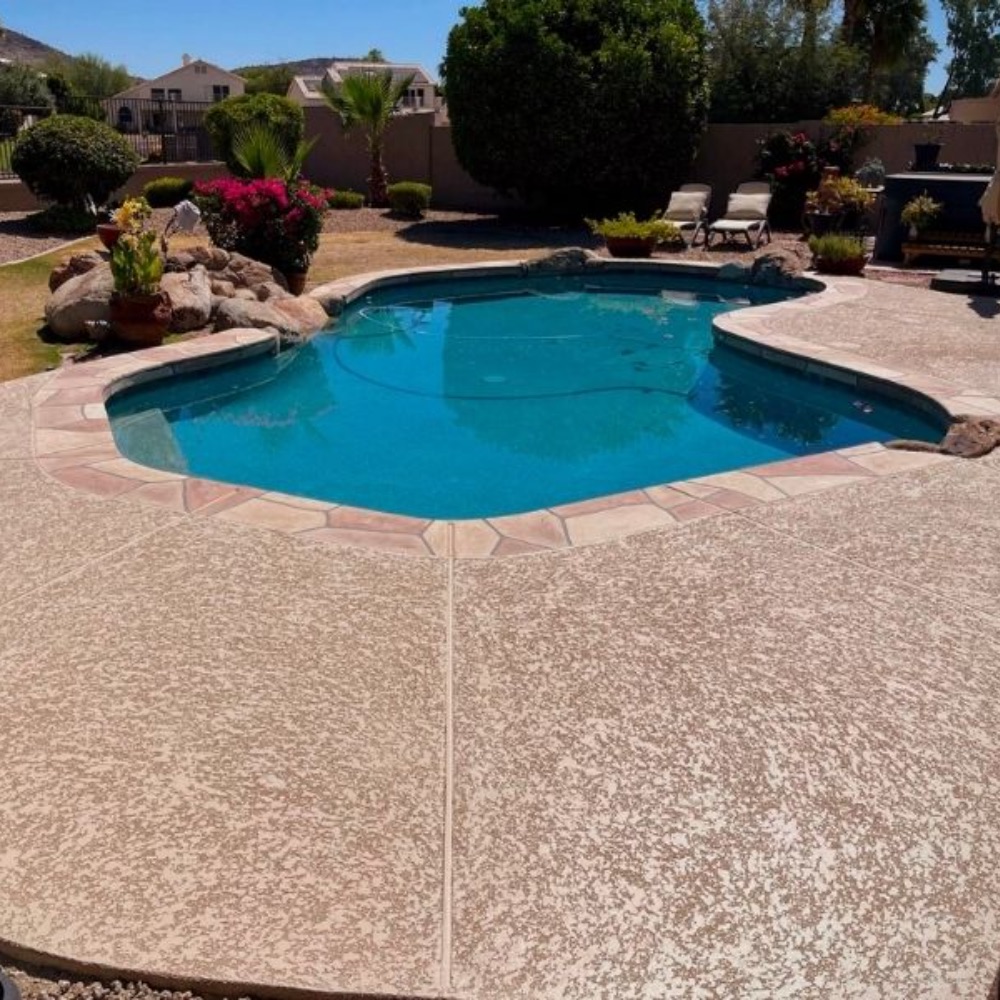
Commercial Pool Deck Resurfacing for HOA and Club Pools
Commercial pool deck resurfacing is the same trade as a backyard job and almost none of the same project. The concrete behaves identically. Everything around it is different: the season is fixed, the money needs a vote, the liability sits with an association rather than a family, and the deck carries in a week what a residential deck carries in a summer. This is written for the person who has to get it approved and delivered, not for the person who has to swim on it. Getting it inside the season window The calendar is the first constraint and it is unforgiving. A community pool in north Georgia has a season, and the deck work has to happen outside it or in the shoulder either side. Work backward. If the pool opens in late spring, the work needs a dry window before that, which means the contractor needs to be holding a slot months earlier, which means the board needs to have voted before that, which means the bids need to be in hand over the winter. Boards that begin looking in March are competing with every other board that also left it until March, and they end up choosing between a rush premium and losing the season. The other half of the timing question is the weather during cure, and whoever is quoting has to be working locally enough to move a crew when a storm front changes the week. That is what the areas we cover establishes. What commercial pool deck resurfacing has to survive Residential decks see a family. Community decks see a few hundred people in a weekend, most of them barefoot and wet, many of them children, plus furniture dragged across the surface twice a day and a maintenance routine that is done by whoever is on duty rather than by the owner who paid for the deck. That changes the specification. The wear pattern on a community deck is concentrated along the routes between the gate, the restrooms and the pool steps, and those lines will show first. Sun exposure on a large open deck is total, so pigment stability matters more than it does on a shaded residential deck. And the cleaning regime is going to be harsher than a homeowner’s, which the sealer has to tolerate. The underlying service is the same one on the pool deck resurfacing page, specified harder. Slip resistance is a liability question here, not a comfort one On a residential deck, texture is a preference. On a community deck, it is the thing the association will be asked about if somebody falls. Specify the texture for wet grip and let comfort be the second criterion rather than the first. Carry the same texture continuously across every change of level, because a change of grip at a step edge is where people go down. Pay attention to the shaded corners, because the biological film that grows on a permanently damp deck is the most common cause of a slip on a surface that was perfectly safe when it was installed, and it is a cleaning schedule problem rather than a specification one. The detail is in texture and slip resistance. If there is an accessible route across the deck, check what applies locally before finalising levels and transitions, because that is a compliance question rather than a finish question and it is easier to answer before the work than after it. Large decks have large drainage problems A residential deck sheds water across a few metres. A community deck may have to move it across a large open area, around planting beds, past equipment enclosures and through channel drains that nobody has lifted a grate on in three years. Get the drains surveyed before the deck is quoted. Silted channel drains are extremely common on community properties and they are the cheapest thing on the whole project to fix. Ponding on a large deck is not just a maintenance problem, it is a slip and a mosquito problem, both of which the association hears about. This is covered in drainage and standing water. Phasing, and whether the pool can stay open Closing the whole facility is cheapest and fastest. It is also the option a board is most likely to be shouted at for. Phased work, where sections are barriered off in sequence while the rest of the deck stays in use, is possible and it costs more, because the crew mobilises repeatedly, works around barriers and loses the efficiency of an open site. If phasing is wanted, it belongs in the proposal in detail: which areas close in which order, how long each phase runs, how access to the gates and restrooms is maintained throughout, how barriers are secured overnight, and what happens if weather pushes a phase. Understanding the underlying sequence makes those conversations far shorter, and it is set out in what happens on site. What the board actually needs in front of it Document Why the board needs it Written scope naming preparation and joint treatment Makes competing bids comparable rather than just differently priced Repair allowance with a stated rate for extra Prevents a mid project change order arriving with no approval route Certificate of insurance direct from the insurer The association carries the exposure if it is missing Workers compensation evidence Same reason, and it is frequently overlooked Product data for each coat Lets a technical board member check the specification independently Full warranty including exclusions The board is voting on a multi year commitment, not a finish References from comparable properties A community deck is not a large residential deck Closure window as dates, not durations The membership will be told a date and will hold the board to it The nine checks that apply to any deck contractor apply here too, and they are in choosing a contractor. The warranty deserves reading properly before the vote rather than after it, which is covered in what a warranty covers. For


