
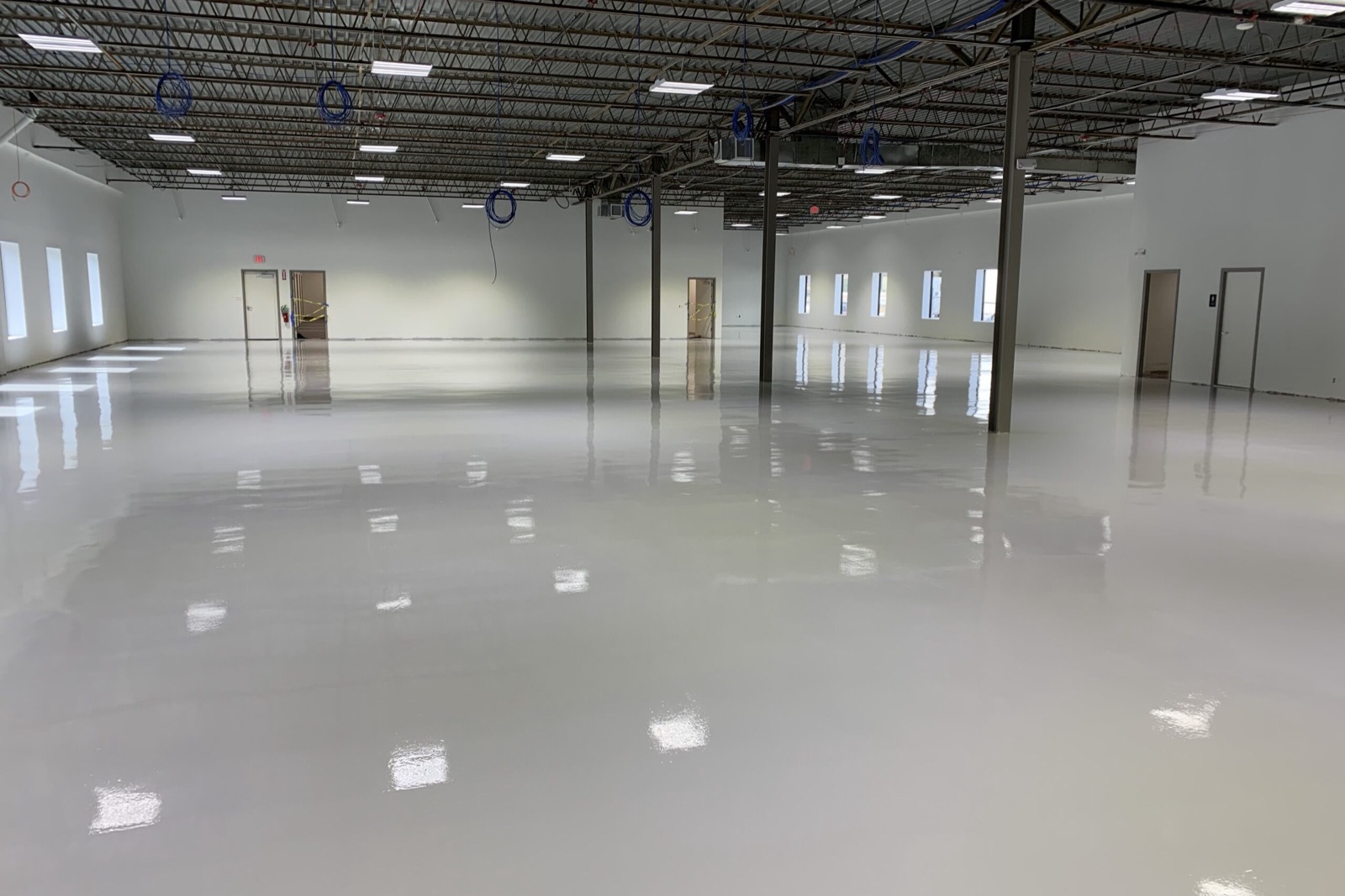
Electrostatic discharge damage is invisible, intermittent and expensive. A component that took a static hit on an assembly floor may work on the bench, fail in the field, and never be traced back to the floor it was walked across.
That is why electronics manufacturing, certain cleanroom and medical environments, and facilities handling flammable atmospheres specify a floor that controls static rather than one that merely resists it. The distinction between those two is where most of the confusion on this subject lives.
Antistatic, dissipative and conductive are three different things
- Antistatic generally means the surface resists the generation of static charge. It says nothing about where charge goes once it exists, and many ordinary coatings are marketed this way.
- Static dissipative means the floor conducts charge away to ground, slowly and in a controlled way. Slow is the point: a controlled bleed to ground prevents both the build-up and the sudden discharge.
- Conductive means the floor conducts charge away quickly. It is specified where fast dissipation matters more than a controlled rate, such as some munitions, solvent and flammable-atmosphere environments.
These are performance categories defined by measured electrical resistance, and the required range comes from the standard your operation works to and from your own static control program. A supplier describing a product as antistatic without a resistance range has not told you what you need to know.
The floor is one component of a system
This is the part most often misunderstood, and it is the reason some installed floors control nothing. Charge has to have a path from the person or the cart, through the floor, to a ground connection. That means the system includes grounding straps or points connected to building ground, installed during the coating process and bonded to the conductive layer.
It also means footwear matters. A dissipative floor walked on in ordinary insulating shoes does not drain a person’s charge. Static control footwear, heel straps or conductive cart wheels are the other half of the circuit, and a facility that installs the floor and skips the footwear program has bought a floor that tests correctly and controls nothing. And performance is measured as installed and in service, which means the testing plan matters as much as the installation.
How the system is built
A typical resin static control floor is a layered assembly, and each layer has a job the others cannot do.
- Primer, to bond to prepared concrete and address moisture where present.
- A conductive layer, which is the path charge travels laterally to reach the grounding points. This is frequently a conductive primer or a grid of copper tape connected to ground points, and the layout of that grid is a design item rather than a site decision.
- The dissipative or conductive topcoat, which carries conductive media through its body so the surface connects electrically to the layer beneath. Its resistance range is the number the specification names.
- Testing and documentation at completion, with resistance readings taken at defined points and recorded. Those records are what a future audit or dispute is settled with.
Each is a line item, and a quote that prices a static control floor without describing the grounding layout and the testing has quoted a topcoat rather than a system.
Surface preparation is not different, and not optional
Everything that governs an ordinary resin floor applies here: mechanical preparation to an appropriate profile, sound concrete beneath, and moisture addressed before anything is applied. Those principles are in epoxy garage floor coating, how surface preparation determines long-term results and concrete floor treatment options for moisture-prone environments.
The static control addition is that a conductive layer bridging a disbonded area will not perform predictably. A floor that fails electrically because the coating is lifting is both a static problem and a coating problem, and neither gets solved without addressing the other.
Testing, and the numbers that matter
Two measurements are normally taken, and they answer different questions. Resistance to ground, measured from a point on the floor surface to the building ground connection, which tells you whether the path exists and what its resistance is.
Point to point resistance, measured between two points on the surface, which tells you about the lateral conductivity of the surface itself. Both are affected by humidity and temperature, so readings are taken under recorded conditions, and a floor measured in one season may read differently in another. That is a normal characteristic rather than a defect, and it is a reason to agree the acceptance criteria and the test conditions before installation rather than argue about them afterward.
Testing is not a one-time event either. A floor in service collects contamination, gets cleaned with the wrong products and wears, all of which change its electrical behavior. A periodic testing schedule is part of owning one.
Cleaning is where these floors quietly fail
This is the most common cause of an installed floor drifting out of specification, and it rarely gets blamed on the right thing. Ordinary floor cleaners, and anything that leaves a film such as a polish or a wax, insulate the surface. A maintenance crew using a general-purpose product will take a compliant floor out of range without anyone noticing until the next test.
The remedy is specific: approved cleaning products written into the maintenance procedure, and a maintenance team that knows why the restriction exists. The general discipline is in concrete floor maintenance checklist for high traffic spaces.
Which facilities actually need one
The honest answer is fewer than ask about it, and the ones that do need it usually know, because the requirement arrives through a customer specification or a quality system rather than through a flooring conversation. Electronics assembly, repair and test operations handling sensitive components are the core case. Cleanrooms and controlled environments frequently carry a static requirement alongside their particulate requirements. Certain medical device, pharmaceutical and laboratory spaces fall into the same pattern. Facilities handling flammable atmospheres, solvents or energetic materials usually need conductive rather than dissipative, because fast dissipation is the safety objective.
What is usually not required is a general warehouse, a shop or an office, even where people notice static shocks in dry winter conditions. That is a humidity question rather than a static control one, and a static control floor is an expensive answer to it. Those spaces are served by the systems described in epoxy flooring for warehouses and production areas.
What belongs in the specification
The required resistance range and the standard it comes from. Whether dissipative or conductive. The grounding design, meaning the conductive layer, the grid layout and the number and placement of ground points. Who makes the connection to building ground. Surface preparation and moisture mitigation. The testing protocol, acceptance criteria and the conditions readings are taken under. The approved cleaning products. And the retest schedule.
A specification with a product name and a square footage leaves every one of those to be discovered during the job, which is the expensive way to find out. Our industrial work is on the commercial and industrial grade epoxy floors pages.
Frequently asked questions
What is the difference between antistatic and static dissipative flooring?
Antistatic generally describes a surface that resists generating charge and says nothing about where charge goes once it exists. Static dissipative means the floor conducts charge away to ground at a controlled rate, which is what protects sensitive components. The categories are defined by measured resistance ranges, so a product described as antistatic without a stated range has not told you what you need.
Does a static control floor work on its own?
No. The floor is one part of a circuit that also needs grounding points bonded to building ground and footwear or cart wheels connecting the person or equipment to the floor. A dissipative floor walked on in ordinary insulating shoes drains nothing. A facility that installs the floor and skips the footwear program has a floor that tests correctly and controls nothing.
How is the floor tested?
Normally with two measurements: resistance from a point on the floor to the building ground connection, and point to point resistance between two surface locations. Both vary with temperature and humidity, so readings are taken under recorded conditions and the acceptance criteria should be agreed before installation. Testing is periodic rather than one-time, because wear and cleaning change the behavior.
Why did our floor stop meeting specification?
Most often cleaning. Ordinary floor cleaners, and anything leaving a film such as a polish or wax, insulate the surface and take a compliant floor out of range. It happens gradually and nobody notices until the next test. The fix is approved products written into the maintenance procedure, with the maintenance team told why the restriction exists.
Do we need one if people get static shocks in our warehouse?
Usually not. Shocks in a general warehouse or office in dry winter conditions are a humidity issue rather than an electrostatic discharge control problem, and a static control floor system is an expensive answer to it. These floors are specified where sensitive components are handled, in certain controlled environments, and where flammable atmospheres make fast dissipation a safety requirement.